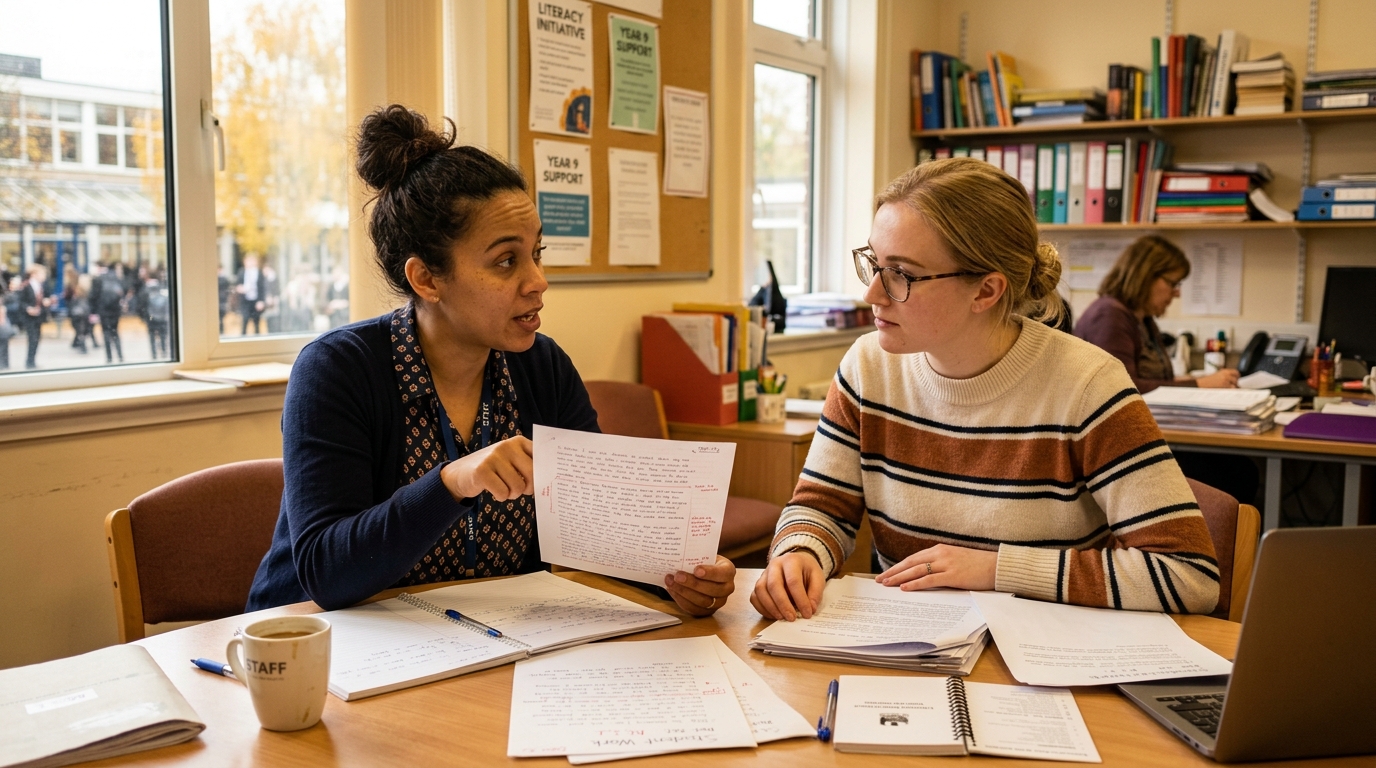
When teams are overloaded, literacy improvement can feel too big to hold. A short, disciplined vocabulary triage meeting helps secondary schools identify the words that matter most and get practical support to students fast.
Why overloaded teams need triage, not one more initiative
In many secondary schools, literacy work is caught in a familiar bind. Teachers know that students need stronger reading, writing, and academic language. Leaders know that literacy affects success in every subject, from science labs to history essays to career pathways. But teams are also managing attendance concerns, behavior needs, unfinished learning, staffing gaps, and the daily pressure of getting through content.
That is why a triage approach matters.
Triage does not mean lowering expectations. It means making smart, time-sensitive decisions about where support will do the most good right now. In a literacy context, a vocabulary triage meeting is a short, structured conversation in which a grade-level or department team identifies a small set of high-value words students are struggling to understand and uses that information to plan immediate support.
This matters because vocabulary is not an extra. It is part of reading comprehension, discussion, writing, and access to complex text. Students cannot fully show what they know in algebra, biology, civics, or English if key terms remain hazy.
The urgency is real. According to the 2024 National Assessment of Educational Progress, average reading scores declined for both fourth and eighth graders compared with 2022, and they remain below pre-pandemic levels. Those results do not tell the whole story of any one school, but they do confirm what many teachers already see: too many students are meeting dense academic language without enough support.
What a vocabulary triage meeting is
A vocabulary triage meeting is not a full curriculum rewrite. It is a 15- to 25-minute routine, usually held weekly or every two weeks, where teachers answer three practical questions:
1. Which words are currently blocking understanding?
2. Which students or classes need support first?
3. What is the smallest useful response we can deliver this week?
The point is speed and clarity. Teams do not need to debate every possible word in a unit. They focus on the handful of terms that unlock access to the text, task, or assessment in front of students.
In secondary schools, this is especially helpful because vocabulary demands rise sharply across subjects. A student may move from metaphor in English to isotope in chemistry to federalism in social studies to slope in math, all before lunch. Each term has its own concept load, and many words have different meanings across disciplines. Triage helps teams sort what is essential from what is merely nice to know.
Why vocabulary deserves this level of attention
Reading researchers have long noted that comprehension depends on both word knowledge and background knowledge. Students need broad language exposure over time, but they also need direct instruction in the words that carry academic meaning.
Secondary schools sometimes assume that vocabulary should have been “handled” in elementary grades. In reality, adolescents continue to need explicit support with morphology, multiple-meaning words, discipline-specific language, and the language structures used in academic discussion and writing.
High-performing systems often reflect this seriousness about language. Students in places such as Singapore, Estonia, Canada, and Finland tend to perform strongly on international assessments like PISA, but there is no magic trick to copy. What is worth noticing is the steady emphasis on coherent curriculum, teacher collaboration, and language-rich instruction across subjects. The lesson for US schools is not that they should import another country’s model wholesale. It is that literacy improvement usually comes from consistent, organized practice, not isolated programs.
What happens in the meeting
The strongest triage meetings are disciplined and brief. A facilitator, coach, department chair, or teacher team lead can use a simple agenda:
First, bring evidence. That may include exit tickets, short writing samples, common assessment items, annotation checks, or even a quick list of student questions heard in class. The evidence does not have to be formal. It just has to be current.
Second, identify the words causing the greatest friction. These are often not the fanciest terms. They may be everyday academic words like analyze, justify, infer, contrast, factor, or significant. In many classrooms, Tier 2 and Tier 3 words both matter: general academic language and subject-specific terms.
Third, sort the words into three categories:
- Teach now: words students need in the next few days to access core learning
- Reinforce soon: words worth revisiting in warm-ups, homework, or small-group support
- Track only: words to monitor but not prioritize this week
Fourth, decide on the response. Keep it realistic. One class may need a quick morphology mini-lesson. Another may need sentence frames for discussion. A third may benefit from a short retrieval routine using visuals and examples.
Finally, assign ownership. Who will create the slide? Who will add the terms to the shared word bank? Who will check whether multilingual learners or students with IEPs need adapted supports? Triage works when the next steps are visible and manageable.
What schools often get wrong
The most common mistake is trying to do too much.
Overloaded teams do not need a 40-word weekly list, a new software platform, and a schoolwide mandate that every teacher use the same script. That approach usually creates compliance fatigue, not better instruction.
Another mistake is treating vocabulary as memorization only. Students do need repeated exposure, but copying definitions is rarely enough. They need to hear words, use them in speaking and writing, connect them to concepts, notice roots and affixes, and revisit them over time.
A third mistake is leaving literacy to the English department alone. In grades 6-12, the language demands of content areas are too significant for that. Disciplinary literacy matters because reading a poem, a lab report, and a Supreme Court excerpt requires different kinds of language knowledge.
A realistic model for secondary schools
If your team is stretched thin, start small.
Choose one grade level or one department. Meet for 20 minutes once a week. Limit the group to the teachers who can act on the decisions immediately. Use one shared template with four columns: target words, evidence of need, support plan, and person responsible.
Then build a predictable response menu. For example:
- A two-minute word preview before reading
- A mini-lesson on roots, prefixes, or suffixes
- One model sentence and one student practice sentence
- A quick visual or non-example to clarify meaning
- A retrieval check two days later
- One writing prompt that requires using the word accurately
This kind of routine respects the reality of school life. Teachers are more likely to sustain a simple protocol than a complicated one.
How leaders can help without adding pressure
School leaders play an important role here. They can protect time for short team meetings, provide simple data tools, and reduce the number of competing demands. They can also signal that literacy work is everyone’s work while avoiding the message that every teacher must become a reading specialist overnight.
Support matters more than slogans. Leaders can help by giving departments common planning time where possible, sharing strong examples, and making room for coaching. They can ask useful questions: Which words are getting in the way? Which students are not accessing the text? What support can we put in place this week?
That kind of leadership keeps the work human. It recognizes that teachers are already carrying a great deal and that improvement must fit inside real schedules and real classrooms.
Concrete next steps for next week
A vocabulary triage meeting is powerful because it is doable.
Here is a practical way to begin next week:
1. Schedule a 20-minute meeting with one grade-level or content team.
2. Bring one recent piece of student evidence per teacher.
3. Identify no more than five high-priority words.
4. Select one support move all teachers can use within the next three days.
5. Agree on a quick check for whether students can understand and use the words.
6. Repeat the routine the following week and adjust.
Over time, these small meetings can strengthen a school’s literacy culture. They help teams notice patterns earlier, respond faster, and focus scarce energy where it counts most.
In a time when reading outcomes are a national concern and school capacity is stretched, that matters. Not because vocabulary is the whole answer, but because clear, shared attention to language can open the door to stronger comprehension, more confident writing, and fuller participation in every secondary classroom.