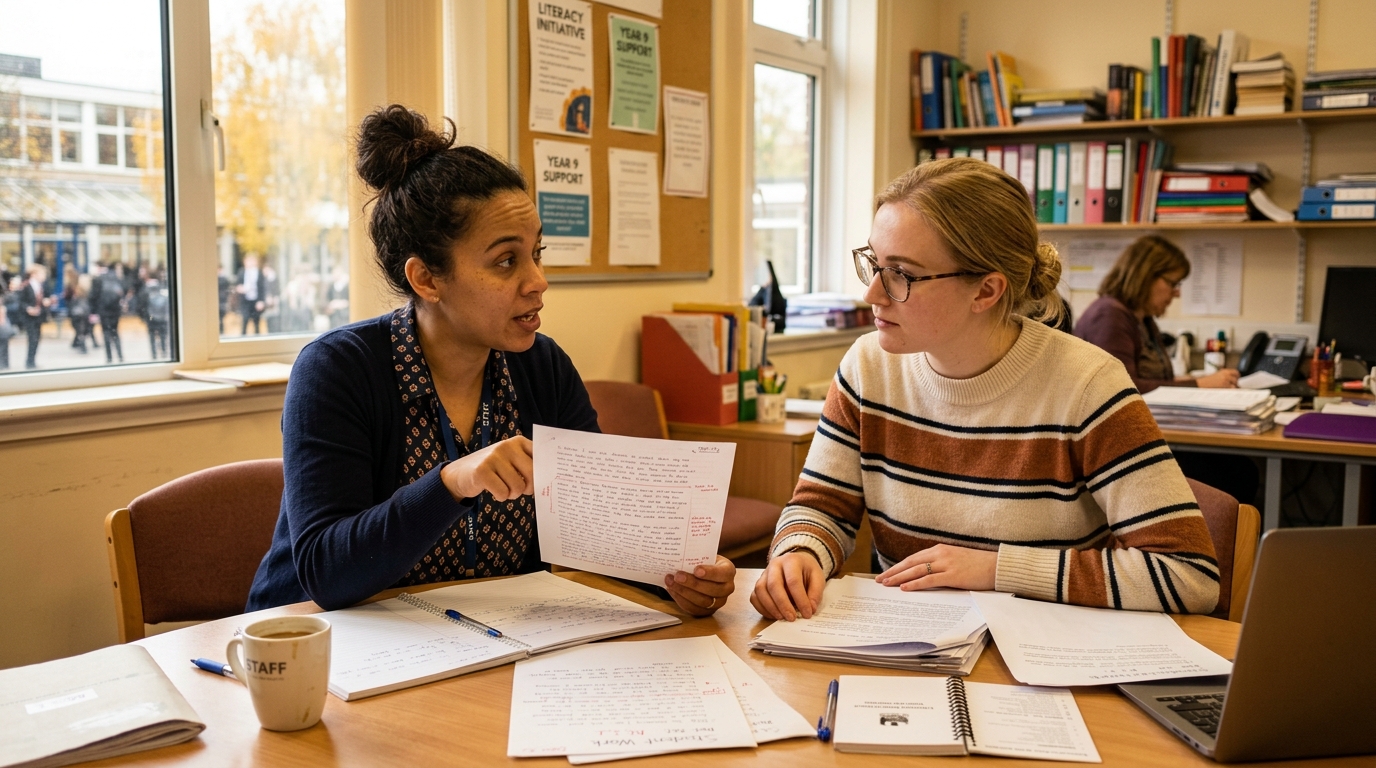
When another referral is about to become the default response, a short grade-team reading conference can redirect a student toward support that actually fits. In secondary schools, better literacy outcomes often begin when adults stop passing the problem along and start solving it together.
When the referral becomes the routine
In too many middle and high schools, a familiar pattern plays out. A student is struggling in English, but also in science, social studies, and math because the reading load keeps getting heavier. The grades slide. The behavior may follow. Someone suggests a special education referral, a counseling referral, or another intervention class. Sometimes those referrals are absolutely appropriate. But sometimes they have become the school’s default way of naming a literacy problem without yet understanding it.
That is where a grade-team reading conference can change the story.
This is not a grand new initiative. It is a short, structured meeting in which the adults who know the student best come together, look at real classroom evidence, and decide on immediate reading supports before another failed referral becomes the next step. In a time of crowded schedules, staffing shortages, and real pressure on teachers, that kind of simple coordination matters.
Why secondary literacy needs urgent attention
Secondary schools are often asked to solve a problem they did not create and do not have enough time to fully repair. By grades 6 through 12, students are expected to read complex texts independently across every subject. Yet many are still missing key skills in decoding, fluency, vocabulary, background knowledge, and comprehension.
The national picture is sobering. According to the 2024 National Assessment of Educational Progress, average reading scores declined for both fourth and eighth graders compared with 2022, continuing a long slide in reading achievement. For many educators, that matched what they were seeing every day: students reading below grade level, avoiding text, or appearing disengaged when the real issue was access.
International comparisons tell a similar story. On the 2022 Programme for International Student Assessment, or PISA, student reading performance dropped across many countries. Even high-performing systems such as Singapore, Estonia, Canada, and Finland have had to respond to changing literacy needs, though some have been more successful than others at building coherent support structures. One lesson stands out: strong reading outcomes are rarely the result of one heroic teacher or one intervention program. They come from systems that notice problems early and respond consistently.
That matters in US secondary schools because adolescent literacy is often everybody’s responsibility and nobody’s protected time.
What a grade-team reading conference is
A grade-team reading conference is a 15- to 25-minute problem-solving meeting focused on one student or a small group of students. The team usually includes the English teacher, at least one content-area teacher, a special educator or interventionist when available, and a counselor, dean, or administrator who can help remove barriers.
The goal is not to diagnose everything in one sitting. The goal is to answer three practical questions:
What reading challenge are we actually seeing?
How is it showing up across classes?
What can we try in the next two to four weeks that is more precise than another generic referral?
That shift matters because “struggling reader” is too broad to be useful. One student may read slowly but understand when given time. Another may decode accurately but have little background knowledge. Another may avoid reading because the text is consistently inaccessible. Another may be learning English and need language support, not assumptions about effort.
A good conference helps adults get specific.
What the team brings to the table
The most useful conferences rely on ordinary school evidence, not expensive new assessments. Teachers bring a recent writing sample, a quiz or exit ticket, notes on class discussion, and a short reading task the student attempted. If the school has screening data, that helps, but it is not required.
The team looks for patterns:
Is the student missing meaning because of vocabulary?
Do they misread key words in every class?
Can they explain a text that was read aloud but not one they read independently?
Are they overwhelmed by text volume, directions, or stamina?
Is attendance part of the picture?
This matters because referrals often fail when they ask the wrong question. A student who needs explicit support with academic vocabulary may instead get labeled unmotivated. A student with weak fluency may be assigned more silent reading. A student who can think deeply about a topic may never get to show it because every assessment depends on unsupported independent reading.
The conference creates a fuller picture before the school escalates to a process that may take weeks or months.
Why this works better than another failed referral
Referrals can be necessary and life-changing when they are timely and accurate. But teachers know the frustration of making a referral that leads to little action, long delays, or a mismatch between the student’s need and the service available.
A grade-team reading conference works better in many cases because it shortens the distance between noticing and responding. It also spreads responsibility. Instead of one teacher carrying the student’s literacy struggle alone, the team agrees on a few shared moves across the day.
That is especially important in secondary school, where students rotate through multiple classes and often receive mixed messages. If one teacher is chunking text, another is assigning pages without support, and another assumes the issue belongs to English class, the student experiences school as a series of separate failures.
The conference helps build coherence. It says: we see the same student, and we are going to respond in aligned ways.
What schools in stronger literacy systems tend to do
High-performing systems do not offer a magical blueprint, and the United States cannot simply import another country’s model. But there are helpful lessons. In places such as Singapore and Estonia, literacy support is often more systematic, with strong teacher development and clearer alignment across schools. Canada and Finland have also invested heavily in teacher capacity and student support structures, though like many countries they have faced more recent reading declines.
The transferable lesson is not “copy this nation.” It is that literacy improvement depends on coordinated adult action, not isolated rescue attempts. Secondary students do better when schools create routines for teachers to examine evidence together and adjust instruction quickly.
A realistic protocol schools can start now
A workable reading conference does not need a new department or a half-day release.
Choose one student of concern and one facilitator.
Gather four pieces of evidence: a recent reading task, a writing sample, attendance data, and notes from at least two teachers.
Spend five minutes naming the problem as specifically as possible.
Spend five minutes identifying strengths. This matters because students are more than their deficits, and strengths often reveal the best support path.
Spend ten minutes agreeing on two or three actions every relevant teacher can implement for the next two to four weeks.
Set a follow-up date immediately.
The actions should be concrete and observable. For example: preteach five key words before a unit, provide audio plus text for assigned reading, require one short written response using a teacher-modeled sentence frame, chunk longer passages with stop-and-jot prompts, or give the student a brief fluency practice routine with an interventionist.
Practical strategies that fit real schools
To raise literacy rates in grades 6 through 12, schools need strategies that respect actual constraints.
First, teach reading in every subject without pretending every teacher must become a reading specialist. Content teachers can model how experts read in their disciplines: sourcing a document in history, unpacking dense syntax in science, or interpreting symbolic language in math problems.
Second, make vocabulary instruction routine and selective. Focus on high-utility academic words and the key discipline-specific terms that unlock a unit.
Third, protect intervention time for students with the greatest need. If staffing is limited, use short-cycle support targeted to a specific problem rather than placing students indefinitely in generic remediation.
Fourth, use read-alouds, audio supports, and guided reading of complex text without shame. These are access supports, not shortcuts.
Fifth, review referral patterns. If large numbers of students are being referred before teachers have tried common reading supports, the system may be signaling a capacity problem, not a student problem.
Finally, build a simple meeting habit. A 20-minute grade-team reading conference every week or two can prevent months of drift.
Secondary literacy work is hard because it asks schools to do urgent, detailed teaching inside already overfilled days. But students do not need perfection from us. They need adults who are coordinated, curious, and willing to act before another failed referral tells them, once again, that no one really knows what to do.
Sometimes literacy improvement begins there: not with a bigger program, but with a better conversation.