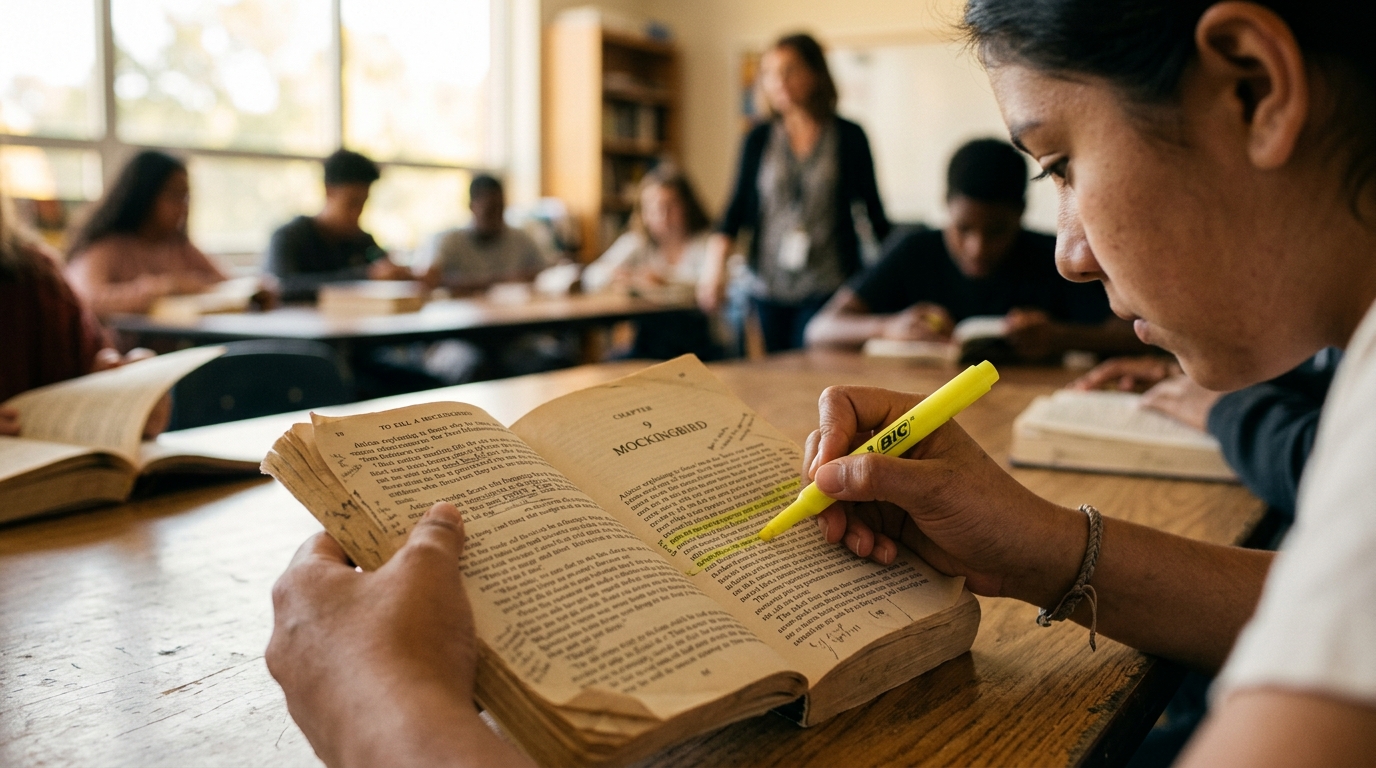
A short, protected homeroom can help middle and high schools raise literacy without turning every class into remediation. The key is a morale-safe plan that builds reading strength, preserves student dignity, and respects teachers’ real workload.
Why secondary literacy needs a different plan
By grades 6-12, reading problems rarely look simple. A student may decode accurately but read too slowly to keep up in science. Another may read a chapter but miss the author’s argument. Some students are multilingual learners still building academic English. Others have gaps from interrupted schooling, chronic absenteeism, or years of avoiding reading because it has become a public source of embarrassment.
That is why secondary schools need something more practical than a slogan about “every teacher a reading teacher.” Content teachers absolutely support literacy, but they also have standards to teach, labs to run, essays to assess, and classes with a wide range of needs. A morale-safe literacy plan respects that reality. It does not dump a full intervention system onto already stretched departments.
The need is real. On the 2022 National Assessment of Educational Progress, often called the Nation’s Report Card, average reading scores fell for both 8th and 12th graders, continuing a long concern about adolescent literacy. NAEP reported that 31% of 8th graders scored at or above Proficient in reading in 2022, down from 34% in 2019. That does not mean the other students “cannot read,” but it does mean many are not yet reading at the level schools expect for strong, independent academic work.
A secondary response has to be dignified, efficient, and visible enough to matter. That is where a Reading Recovery Homeroom model can help.
What “Reading Recovery Homeroom” means in secondary school
This is not the classic early-years Reading Recovery program used in primary grades. In a secondary setting, “Reading Recovery Homeroom” is a protected 20-30 minute block, three to five days a week, focused on rebuilding reading stamina, fluency, vocabulary, and comprehension through structured routines.
The word recovery matters. Many adolescents are not starting from zero. They are recovering confidence, rebuilding habits, and catching up on missed opportunities to read successfully.
The word homeroom matters too. A homeroom frame lowers the social threat. Students are not being marched into “the low group” in a way that announces failure. The time can be universal, with flexible supports inside it, or it can be scheduled across grade-level advisory so no one group is singled out.
A morale-safe model protects student dignity in at least three ways:
- It normalizes reading practice for everyone.
- It gives students texts they can actually read and discuss successfully.
- It measures growth in ways students can feel, not just in test labels.
Why morale matters as much as method
Secondary students are keenly aware of status. If an intervention feels childish, public, or permanent, many students will resist it no matter how evidence-based it looks on paper. Schools know this from experience. A technically sound program can fail because students see it as punishment.
Morale-safe literacy work is not about lowering expectations. It is about making effort emotionally possible. Students who have spent years believing they are “bad at reading” need repeated experiences of success: finishing an article, understanding a paragraph, discussing a text without fear, and noticing their own increased fluency.
Teachers need morale safety too. They are more likely to support a literacy plan if it is clear, time-bound, and shared across the school rather than added as one more private burden. A workable plan says, in effect: here is the routine, here are the materials, here is the progress-monitoring tool, and here is who handles which part.
What the best international systems suggest
High-performing systems do not offer a single miracle strategy, but they do show some useful patterns. On international assessments such as PISA, systems including Singapore, Estonia, Canada, and Finland have often combined strong academic expectations with coherent supports for struggling readers. The lesson for US secondary schools is not to copy another country whole cloth. Context matters too much for that.
But several transferable ideas stand out: early identification, consistent routines, teacher collaboration, and broad access to reading rather than treating literacy as the job of one heroic specialist. In other words, successful systems tend to make reading support ordinary, structured, and collective.
That is good news for secondary schools, because a homeroom model can do exactly that without redesigning the entire master schedule.
What a Reading Recovery Homeroom can include
The strongest version is simple enough to run well.
First, include a brief fluency component. Older students still benefit from supported repeated reading, partner reading, and teacher modeling, especially when texts are age-respectful. Fluency is not an elementary-only issue; when reading is labored, comprehension and motivation suffer.
Second, build vocabulary in context. Instead of long word lists, focus on high-utility academic words that appear across subjects. Short routines work: preview two or three key words, revisit them in discussion, and ask students to use them in speech or writing.
Third, teach comprehension explicitly. Secondary students benefit from direct modeling of summarizing, questioning, annotating, tracking claims and evidence, and noticing when meaning breaks down. Many students do not need more worksheets. They need to watch a competent reader think.
Fourth, protect time for actual reading. Silent reading by itself is not a full intervention, but guided independent reading with accountability can rebuild stamina and volume. Choice matters here, especially for adolescents whose reading identity has been damaged.
Fifth, add short writing. A two- or three-sentence response helps students consolidate understanding and gives teachers quick evidence of progress.
How to make it workable in real schools
The biggest barriers are predictable: crowded schedules, limited staffing, uneven training, and initiative fatigue. A realistic plan starts small and gets the infrastructure right.
Begin with one grade level or one semester pilot. Use existing advisory or homeroom rather than creating a brand-new period if possible. Keep routines consistent across classrooms so teachers are not inventing everything from scratch.
Use multiple sources to identify students who need the most support: state test data, local screening, course performance, teacher observations, and attendance patterns. Avoid overreliance on any single score. Some students test poorly but read better than expected; others hide difficulties until text demands increase.
Group students flexibly. The goal is not a permanent track. Some students may need intensive decoding support beyond homeroom, especially those with significant foundational gaps or dyslexia-related needs. Homeroom works best as a Tier 1 or light Tier 2 structure, with stronger intervention available for students who need it.
Choose texts carefully. Secondary students deserve content that matches their age and interests, even when the reading level is lower. Nothing kills buy-in faster than materials that feel babyish.
Train staff on a few routines, not fifty. One strong protocol for fluency, one for vocabulary, one for comprehension discussion, and one quick writing task can be enough. Depth beats novelty.
What leaders should watch for
Principals and district leaders should look for signs that the plan is helping without creating collateral damage.
Are students reading more often and with less visible avoidance?
Are teachers using common routines with reasonable confidence?
Are course teachers noticing improved stamina with assigned texts?
Are support staff able to target the students who need deeper intervention rather than spending all their time patching basic gaps for everyone?
And just as important: is the initiative preserving dignity? If students experience the block as a place where they can succeed, schools are far more likely to sustain the work.
A realistic way forward
Secondary literacy improvement is hard because it sits at the intersection of skill, identity, attendance, motivation, and opportunity. There is no quick fix, and teachers know that better than anyone. But schools do not need a miracle to make progress.
A practical Reading Recovery Homeroom can help if it follows a few non-negotiables: protect a short block of time, make participation normal rather than stigmatizing, use age-respectful texts, teach a small set of routines well, monitor growth regularly, and connect homeroom support to stronger interventions when needed.
Most of all, treat adolescent readers as people, not problems to be sorted. When schools combine clear structure with dignity, students are more willing to try again. And in literacy, that willingness to try again is often where recovery begins.