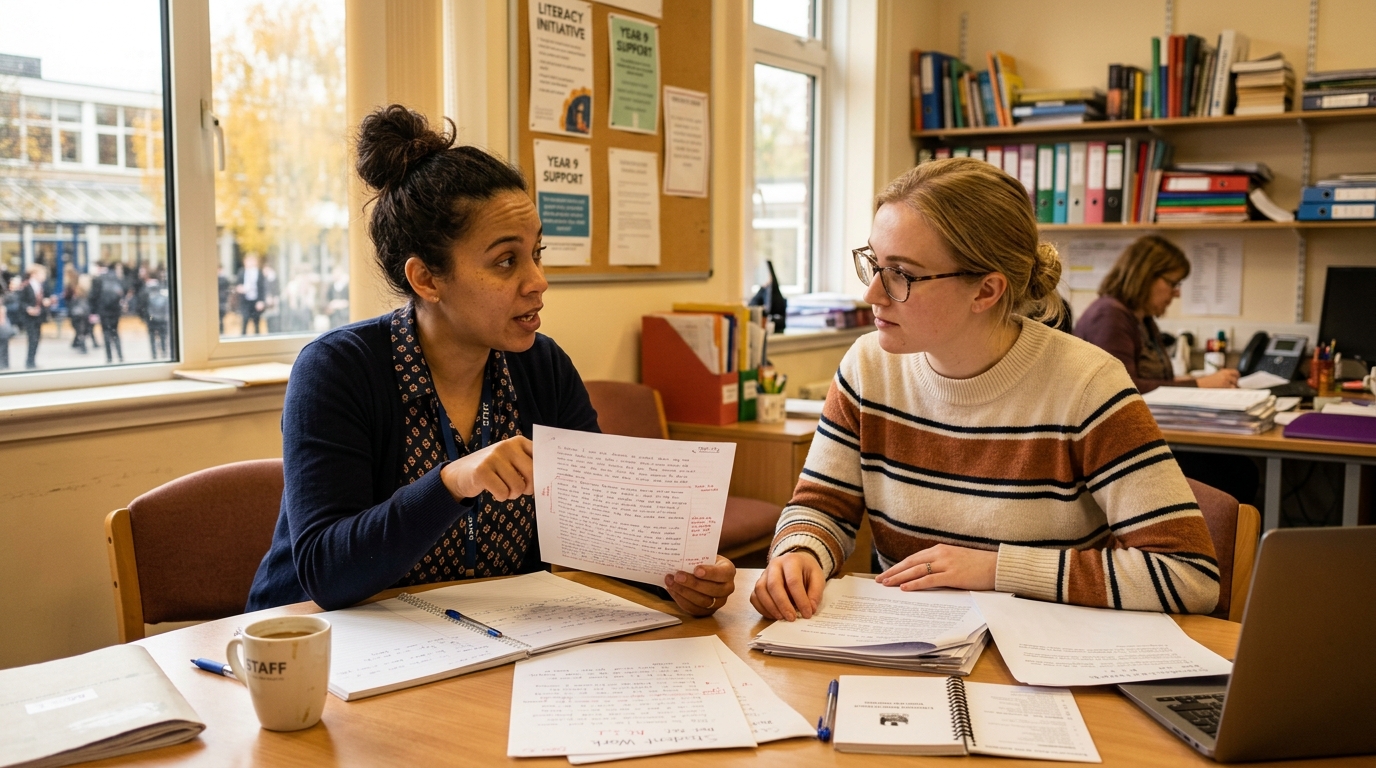
In many middle and high schools, reading time is not absent so much as scattered, interrupted, or quietly replaced. A simple schedule audit can help schools find realistic, protected minutes for literacy without pretending teachers have endless time.
Why secondary schools need a different literacy conversation
When reading results stall, secondary schools often hear two unhelpful messages at once: raise expectations and add interventions. Both matter, but neither solves a basic problem hiding in plain sight. Many students in grades 6–12 simply do not get enough protected, purposeful time to read, discuss, and write about complex texts during the school day.
That matters because the need is real. On the 2022 National Assessment of Educational Progress, average reading scores fell for both 8th and 12th graders, continuing a troubling national pattern reported by the National Center for Education Statistics. Those results do not mean teachers are failing. They do mean schools are working against strong headwinds: larger academic demands, chronic absenteeism, unfinished learning, staffing shortages, and schedules built around credit requirements more than literacy development.
In elementary school, reading time is easier to see. In secondary school, it is often hidden inside content classes, advisory, intervention blocks, test prep, or homework expectations. That is why a schedule audit can be so powerful. It does not ask, “Do we value literacy?” It asks a more practical question: “Where, exactly, are students getting minutes to read?”
What a schedule audit actually is
A schedule audit is a careful look at how a school uses instructional time across a week. The goal is not to shame departments or force every class to become English class. The goal is to identify where literacy time already exists, where it is being fragmented, and where small changes could create more consistent reading opportunities.
In grades 6–12, schools often assume students are reading all day because every class uses text. But using text is not the same as teaching students how to navigate it. A student may encounter a lab procedure, a textbook page, a primary source, and a word problem in one day without ever having sustained time to read with support.
A good audit looks for three things:
1. Protected reading time: minutes when students are expected to read independently or closely with teacher support.
2. Instructional reading time: explicit teaching of comprehension, vocabulary, fluency, and discussion around text.
3. Lost reading time: minutes planned for literacy that disappear because of transitions, announcements, device issues, make-up work, behavior management, or assemblies.
This is less glamorous than adopting a new program, but often more revealing.
Where the lost minutes usually go
Most secondary schools do not lose reading time in one dramatic place. They lose it a few minutes at a time.
A 50-minute class may begin with 6 minutes of settling in, 4 minutes of announcements, 8 minutes reviewing yesterday’s task, and 7 minutes distributing materials or troubleshooting technology. By the time students actually start reading, the class is half over. No one caused this alone. It is the predictable result of busy schools trying to do many things at once.
Common pressure points include:
- Short periods that make sustained reading difficult.
- Pull-outs for services, assessments, or support that interrupt core instruction.
- Intervention blocks used for missing assignments instead of literacy support.
- Advisory periods with unclear academic purpose.
- Excessive transitions, especially in large campuses.
- Device dependence that turns reading time into login time.
- Test-prep routines that replace authentic reading with isolated practice items.
At the high school level, another issue appears: literacy is treated as the English department’s job. Yet adolescents need reading instruction across disciplines. Science asks students to read for procedure and evidence. History asks them to source and contextualize. Math asks them to decode language precisely. Career and technical courses ask them to interpret manuals, diagrams, and workplace texts. If literacy lives in only one period, many students will never get enough practice.
What strong systems do differently
High-performing systems internationally do not offer a magic schedule, but they do show a pattern: literacy is treated as everybody’s business and time is used intentionally. Countries such as Estonia, Singapore, Canada, and Finland have often performed strongly on PISA reading, as reported by the OECD. Their contexts differ from those in the United States, so schools should be cautious about copying structures directly. Still, one lesson travels well: strong reading outcomes are supported by coherent systems, not scattered add-ons.
In practical terms, coherent systems protect time for reading, train subject-area teachers to support disciplinary literacy, and reduce fragmentation. They do not assume adolescents become fully independent readers by middle school.
That lesson applies in the United States too. Schools making progress often do not start with a brand-new initiative. They start by simplifying the day so students can read more consistently and teachers can teach more deeply.
How to run the audit without creating resistance
A schedule audit works best when it feels like problem-solving, not surveillance. Teachers already know time is tight. They do not need another process that ignores reality.
Start with one representative week. Gather bell schedules, intervention rosters, assembly calendars, advisory plans, and a sample of class routines across grades 6–12. Then ask teams to estimate and, if possible, observe:
- How many minutes per week students spend actually reading in each subject.
- How often reading is interrupted.
- Which students miss literacy-rich classes most often because of services or scheduling conflicts.
- Whether intervention time is consistent or constantly repurposed.
- Where students are expected to read independently without enough support.
Then compare the planned schedule with the lived schedule. That gap is where the most useful conversations happen.
For example, a school may believe students receive daily reading practice in English, social studies, and science. The audit may show that only English includes regular sustained reading, while the other classes rely mostly on teacher talk, short excerpts, or slides. That is not a failure; it is clarity.
What schools can do next
Once schools see the time problem clearly, they can make realistic changes.
First, protect a small number of non-negotiable reading routines. Ten to fifteen focused minutes, used consistently, can matter more than occasional big literacy events. Secondary students benefit from regular opportunities to read grade-appropriate text, annotate, discuss, and revisit meaning.
Second, build literacy into content-area planning instead of layering it on top. A history team might identify one common sourcing routine. A science team might teach how to read data-rich explanations. A math team might focus on unpacking academic vocabulary in word problems.
Third, reduce avoidable interruptions. Schools cannot eliminate every announcement or schedule change, but they can cluster noninstructional tasks, streamline transitions, and protect certain periods from routine disruptions.
Fourth, use intervention time for actual intervention. If a support block becomes a study hall for incomplete work, struggling readers lose the very instruction they need. Clear entry and exit criteria, common materials, and trained staff help those minutes count.
Fifth, check equity. Students who most need reading support are often the ones missing the most instruction because of absences, discipline removals, competing services, or unstable schedules. An audit should track who gets protected literacy time and who does not.
Finally, keep the plan manageable. Schools do not need a master schedule revolution to improve literacy. They may need one redesigned advisory period, one better-protected intervention block, or one shared routine across departments.
The goal is not more pressure. It is more usable time.
Secondary literacy improvement is hard because adolescence is complex and school days are crowded. Teachers are asked to cover content, support wellbeing, manage behavior, prepare students for exams, and respond to wide reading differences in the same room. Any honest plan has to start there.
A schedule audit is helpful because it respects that reality. It does not promise a miracle. It simply helps schools find minutes that are already slipping away and use them more deliberately.
That is often where improvement begins: not in adding one more thing, but in protecting what matters long enough for students to actually read.