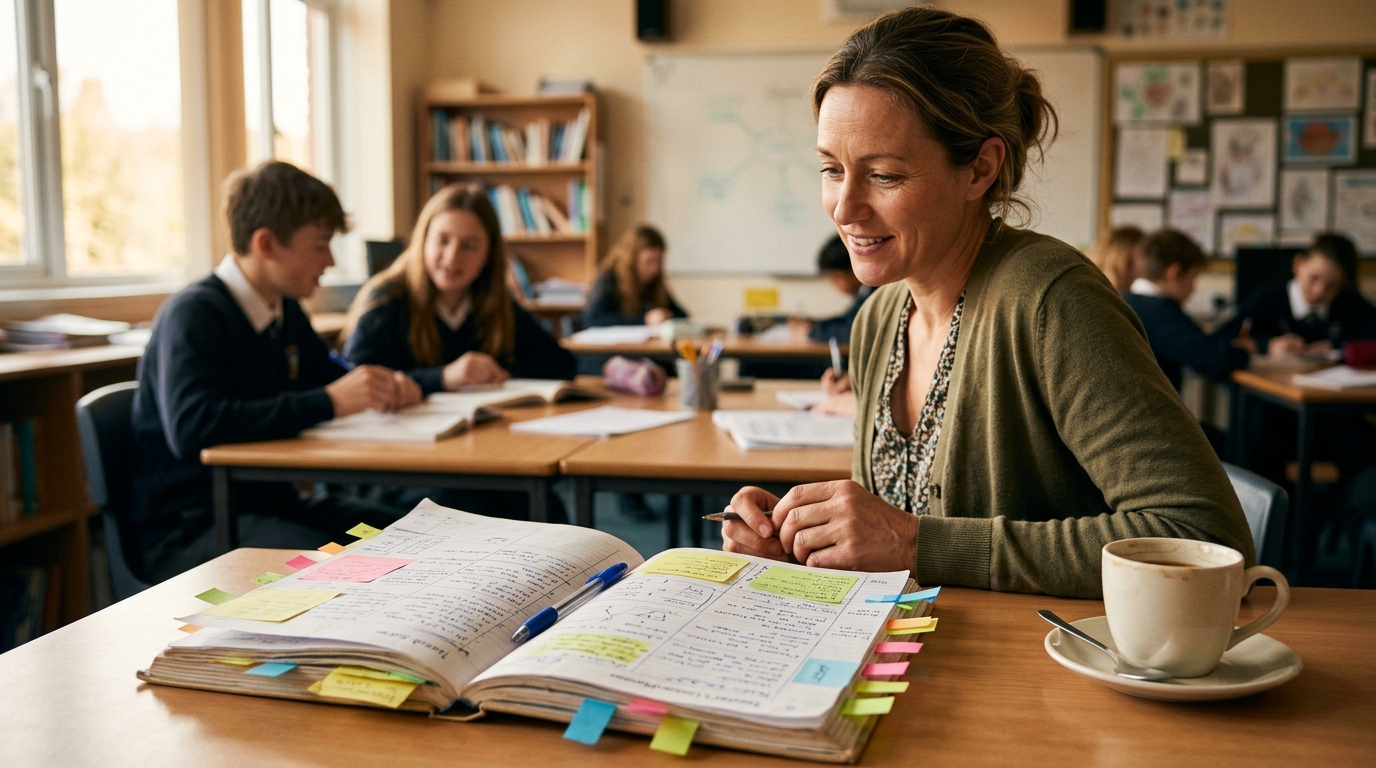
A simple, well-designed exit ticket can help secondary teachers spot the reading gaps that grades and behavior often hide. Here’s how to use one quick routine to improve literacy without adding a whole new program.
In many middle and high school classrooms, reading difficulties do not announce themselves clearly. Students can be thoughtful in discussion, compliant in class, and even pass assignments with support, while still struggling to make sense of grade-level text on their own. By the time those gaps become obvious, students are often discouraged, teachers are stretched thin, and intervention time is already hard to find.
A smart exit ticket will not solve adolescent literacy on its own. But it can do something schools urgently need: reveal hidden reading gaps quickly enough to respond.
That matters because the need is real. On the 2022 National Assessment of Educational Progress, often called the Nation’s Report Card, average reading scores fell for both 8th and 12th graders compared with previous years. NAEP also reported that 31% of 8th graders performed at or above Proficient in reading, a decline from 33% in 2019. Those numbers do not mean students or teachers are failing; they reflect the cumulative effects of disrupted learning, uneven access to support, and long-standing opportunity gaps. Still, they are a clear reminder that secondary schools cannot treat reading as someone else’s job.
Why reading gaps stay hidden in grades 6–12
In elementary school, reading struggles are often easier to spot. In secondary settings, they are easier to mask.
Students learn coping strategies. They listen carefully to peers, rely on slides instead of text, skim for key words, or wait for the teacher to explain. Some are highly verbal and sound confident in discussion, even when their independent comprehension is shaky. Others avoid reading-heavy tasks altogether and are labeled disengaged when the deeper issue is access.
Secondary teachers also face real constraints. A science teacher may see 150 students a day. An English teacher may assign writing but have limited time to diagnose whether weak responses come from reading comprehension, vocabulary, background knowledge, attention, or motivation. Schools may have one literacy specialist for an entire building, or none. In that environment, teachers need tools that are quick, specific, and usable tomorrow.
What a good reading exit ticket actually does
The best exit tickets do more than check whether students were paying attention. They isolate a reading move.
That is the key idea. If a student misses a content question, it is not always clear why. But if the exit ticket is built around one short passage and one or two carefully chosen prompts, the teacher can see much more precisely what is breaking down.
A useful secondary reading exit ticket usually asks students to do three things:
1. read a short, grade-appropriate passage independently;
2. answer one question about what the text says;
3. answer one question about how the text works.
That second part matters. Many students can retrieve a detail but struggle to infer, interpret a word in context, follow an argument, or connect evidence to a claim. Those are the hidden gaps that often undermine performance across subjects.
A simple structure teachers can use
The most effective version is short enough to use in three to five minutes.
Here is a practical template for grades 6–12:
- A passage of 80 to 200 words from the day’s text, or a closely related text
- Question 1: What is the most important idea in this passage?
- Question 2: Which sentence or phrase best supports your answer?
- Question 3: What word, phrase, or part of the passage was hardest to understand?
This format works because it surfaces both comprehension and self-awareness. Question 1 checks whether the student can identify central meaning. Question 2 checks whether they can anchor that understanding in evidence. Question 3 gives the teacher a fast window into vocabulary, syntax, and confusion points.
In history, the passage might come from a primary source. In science, it might explain a process or summarize a claim based on data. In English, it might come from a novel, poem, or informational text. In math, it could focus on a word problem or a short explanation of reasoning. Disciplinary literacy matters in every subject, and this routine respects that.
What teachers should look for in the responses
The goal is not to grade every answer in detail. The goal is to sort students into patterns.
When teachers review exit tickets, four patterns usually emerge:
- Students who understand the main idea and cite relevant evidence
- Students who grasp part of the passage but choose weak or unrelated evidence
- Students who can copy a detail but cannot explain the main idea
- Students whose confusion centers on vocabulary, sentence structure, or text organization
Those patterns matter more than a raw score. They tell the teacher what kind of support is needed next.
For example, if many students identify the wrong main idea, the text may be too complex without enough modeling. If students choose irrelevant evidence, they may need practice distinguishing central ideas from interesting details. If they name the same confusing phrase, that points to a vocabulary or syntax issue worth reteaching.
This is where the exit ticket becomes powerful: it turns vague concern into actionable information.
Why this matters beyond English class
Adolescent literacy is not only about literature. Students read arguments in social studies, procedures in science, explanations in math, and technical texts in career pathways. When they cannot unpack those texts, content learning slows down everywhere.
High-performing systems internationally have long taken literacy seriously across the curriculum. Countries such as Canada, Estonia, Finland, and Singapore have often performed strongly on PISA reading, though their approaches differ. What they tend to share is not a magic worksheet but coherent attention to language, comprehension, and teacher expertise. The lesson for US secondary schools is not to copy another country wholesale. It is to remember that reading development continues well beyond the primary grades.
How to make the routine sustainable
Teachers do not need another initiative that disappears in six weeks. For this to work, schools should keep it simple.
First, use the routine once or twice a week, not every day. Consistency matters more than frequency.
Second, create a small shared bank of text-dependent question stems by department. That reduces planning load and improves quality.
Third, use quick coding instead of lengthy marking. Teachers might sort responses with labels such as MI for main idea, EV for evidence, VOC for vocabulary, and INF for inference. In two minutes, a stack of exit tickets can reveal the next instructional move.
Fourth, build in response options. A student who struggles with writing may show comprehension better by circling evidence and adding a brief note. The goal is to uncover reading needs, not to let writing difficulties hide them.
Fifth, make follow-up visible. Students should see that the exit ticket changes instruction. If the class struggled with transition words in a science explanation, teach that directly the next day. If a small group could not identify the claim in a historical speech, pull them for a brief reteach. When students see the point of the routine, buy-in improves.
What schools can realistically do next
Schools trying to raise literacy rates need practical steps, not blame.
A realistic starting point is this:
- Ask every secondary department to pilot one common reading exit ticket format for one grading period.
- Give teachers 15 minutes in team meetings to look for patterns, not to complete paperwork.
- Train staff to distinguish comprehension issues from motivation or behavior issues.
- Use intervention time for targeted support based on actual response patterns.
- Keep expectations modest at first: better diagnosis, then better instruction, then better outcomes.
None of this removes the larger challenges schools face: staffing shortages, limited intervention blocks, chronic absenteeism, and wide variation in student readiness. But it does offer a manageable way forward.
The exit ticket that flags hidden reading gaps fast is not flashy. It is a disciplined habit: short text, sharp question, quick review, immediate response. In a time when many secondary educators are being asked to do more with less, that kind of clarity matters.
Students in grades 6–12 do not need schools to assume they either can read or cannot. They need schools to notice exactly where comprehension breaks down, and to do something about it while there is still time. A good exit ticket helps teachers see what was previously hidden. That is a small move with serious potential.