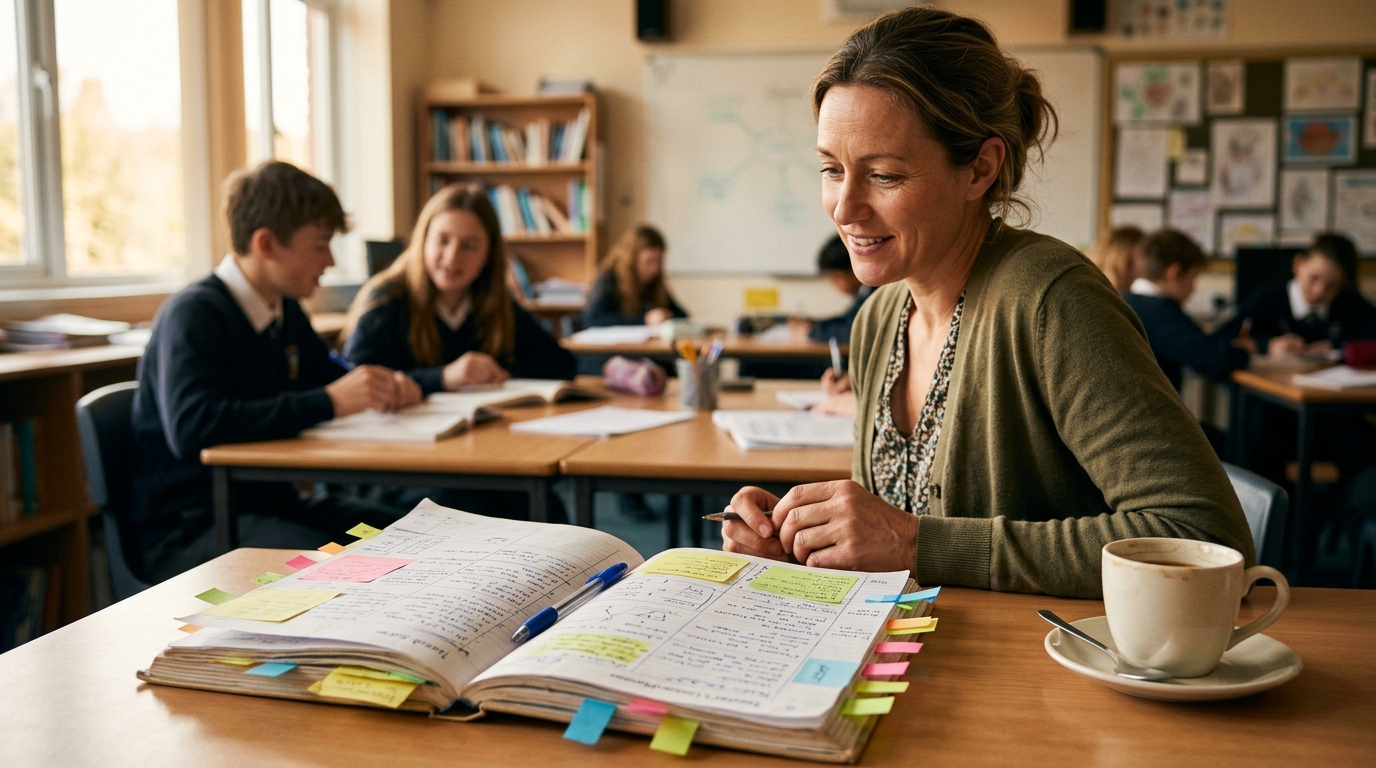
For secondary students who are two years behind in reading, one more generic intervention period is rarely enough. A well-designed Reading Apprenticeship elective can build stamina, vocabulary, confidence, and the disciplinary reading habits students need to succeed across grades 6–12.
Secondary schools know this student well: bright in conversation, capable in hands-on work, but defeated by grade-level text. By middle or high school, many students who are two years behind in reading have already absorbed a painful message about themselves. They are not just struggling with comprehension or vocabulary. They are often struggling with identity, motivation, and the accumulated effects of missed instruction, interrupted attendance, limited practice, or years of reading that felt public and humiliating.
An elective built on a Reading Apprenticeship approach offers a humane and practical response. Instead of treating reading as a set of isolated deficits, it treats students as apprentices who can learn how experienced readers make meaning. For students in grades 6–12, especially those about two years behind, that shift matters.
Why secondary literacy needs urgent attention
The need is real and visible. On the 2024 NAEP, often called the Nation’s Report Card, average reading scores remained below pre-pandemic levels for both 8th and 12th graders, and a large share of students continued to perform below proficiency. NAEP is not a classroom report card, and “proficient” on NAEP is a high bar, but the overall message is clear: too many adolescents are not reading complex text with confidence.
Schools feel this every day. Teachers in science, history, career and technical education, and the arts are all being asked to teach students who may understand the content when explained aloud but cannot independently process the textbook chapter, article, lab directions, or primary source. The challenge is not limited to English class.
International comparisons tell a similar story about the importance of sustained literacy instruction. On PISA, the OECD’s international assessment of 15-year-olds, systems that perform well in reading such as Singapore, Estonia, and Canada tend to combine strong early literacy foundations with coherent support across the years. The lesson for US secondary schools is not to copy another nation wholesale. It is to recognize that literacy growth does not end in elementary school.
What a Reading Apprenticeship elective is
A Reading Apprenticeship elective is a dedicated course, usually offered in addition to English, for students who need intensive support to become more strategic, independent readers. The phrase comes from a well-known instructional framework that emphasizes metacognition, conversation, and the visible habits of skilled readers.
In practice, that means students are taught to notice what happens in their minds as they read. They learn to slow down, annotate with purpose, identify confusion, reread selectively, connect ideas across paragraphs, and use context and morphology to work through unfamiliar vocabulary. Just as important, they hear adults and peers talk honestly about how difficult reading works.
This is different from a remediation model that gives students only low-level worksheets or stripped-down passages. Students still need decoding and fluency support when those skills are weak, but adolescents also need access to interesting, age-respectful texts and explicit teaching about how reading changes across disciplines.
Why an elective can work for students two years behind
Students who are about two years behind often sit in an uncomfortable middle. They may not qualify for the most intensive specialized support, yet they cannot fully access grade-level work without extra instruction. A targeted elective can fill that gap.
First, it creates time. That may sound obvious, but time is one of the hardest resources for schools to find. Reading improvement requires volume, coaching, feedback, and routine. A short intervention block once or twice a week rarely provides enough of any of those.
Second, it creates safety. Adolescents are acutely aware of status. In a separate class designed around growth rather than embarrassment, students are more likely to take risks, discuss confusion, and rebuild reading stamina.
Third, it makes transfer more likely. The goal is not to help students succeed only in the elective. It is to help them tackle the article in biology, the speech in history, the word problem in algebra, and the manual in a technical course.
What strong design looks like
The strongest elective is not a study hall with packets. It has a clear curriculum, a trained teacher, and a manageable set of goals.
Students need diagnostic information, but they do not need to live inside endless testing. Schools should identify whether the main barriers are decoding, fluency, vocabulary, background knowledge, comprehension, or engagement. For some students two years behind, word-level issues still matter and require explicit, systematic support. For others, the bigger problem is language comprehension, text complexity, and a lack of strategic reading habits.
Instruction should combine several elements: direct teaching of comprehension routines, daily reading of connected text, vocabulary and morphology work, discussion, writing about reading, and regular opportunities for students to reflect on what helped them understand. Texts should be varied and relevant: short nonfiction, articles connected to current classes, speeches, narratives, graphics, and digital texts. Young people are more willing to work hard when the material respects their age and intelligence.
A strong elective also teaches reading in context. Historians source documents. Scientists read for claims and evidence. Mathematicians parse precise language. Career-focused courses ask students to interpret manuals, safety procedures, and technical diagrams. Apprenticeship means making those disciplinary moves visible.
The real barriers schools face
The case for an elective is persuasive. The scheduling is hard.
Secondary schools operate under real constraints: graduation requirements, staffing shortages, crowded master schedules, limited intervention periods, and pressure to protect electives that students love. School leaders also know that pulling students from arts, world languages, or career pathways can create a new inequity while trying to solve another one.
Then there is staffing. A reading elective is only as strong as the instruction inside it. Schools need teachers who understand adolescent literacy, not just generic intervention software. Training costs money. Planning time costs money. Smaller classes cost money.
And motivation is not automatic. A student assigned to a reading elective may hear it as punishment. Families may worry about stigma. Teachers may receive a roster with wide-ranging needs, from interrupted formal education to chronic absenteeism to undiagnosed learning differences.
These challenges are not reasons to avoid action. They are reasons to design carefully.
How schools can make the elective realistic and effective
Start with clear entry criteria. “Two years behind” should mean something concrete, based on multiple measures such as state assessments, course performance, classroom evidence, and a diagnostic reading profile. Avoid placing students into the course simply because they are struggling behaviorally or missing homework.
Protect the course from becoming a dumping ground. Keep class sizes as small as the schedule allows, and assign teachers with both skill and credibility. In secondary settings, relationships matter as much as materials.
Make the class visibly different from remediation students may have experienced before. Use high-interest, age-appropriate texts. Let students talk. Build routines for noticing confusion without shame. Celebrate strategy use, not just correct answers.
Coordinate with core content teachers. The elective works best when students can practice with texts they will encounter elsewhere. Shared vocabulary routines, annotation expectations, and writing structures can help students transfer learning across the day.
Include explicit word study where needed. Some adolescents still need direct work in decoding multisyllabic words, morphology, and fluency. There is no contradiction between honoring students and teaching foundational skills.
Monitor progress in ways teachers can actually sustain. Short reading checks, writing about reading, fluency samples, and student self-reflection often provide more useful instructional information than frequent benchmark tests alone.
Finally, frame the course as opportunity, not deficit. Students are apprentices learning powerful ways to read the world. That message may sound small, but for a teenager who has spent years feeling behind, it can change everything.
A practical path forward
If schools want better literacy outcomes in grades 6–12, they need more than slogans about rigor. They need structures that match the problem. A Reading Apprenticeship elective is not a miracle cure, and it will not erase years of uneven opportunity in one semester. But it can give struggling adolescent readers something many have not had enough of: time, expert teaching, meaningful text, and a reason to believe that reading is learnable.
That is a realistic goal. And in secondary education, realism paired with hope is often where real progress begins.