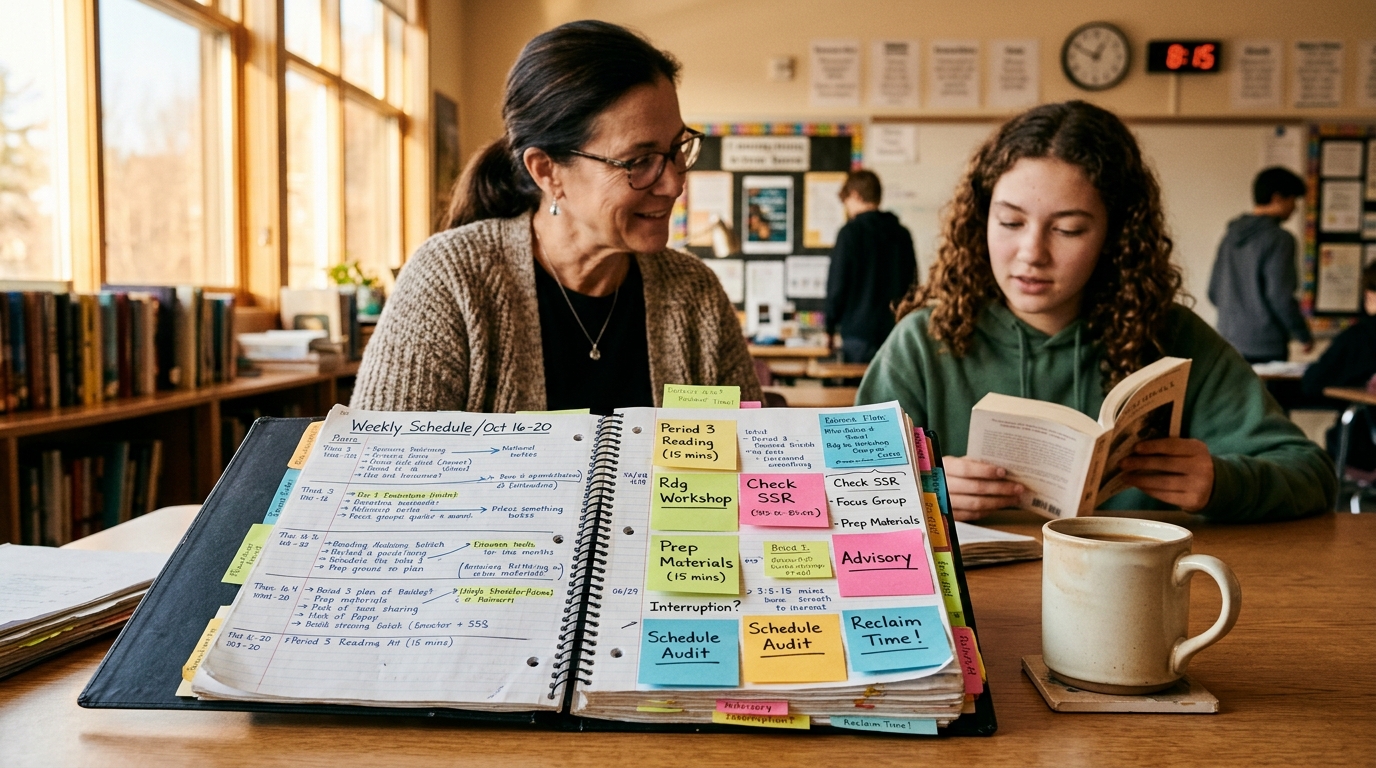
Many secondary students are not just behind in reading skills—they are out of practice with sustained reading. A simple 10-minute text ladder can help schools rebuild stamina, confidence, and comprehension without pretending teachers have extra hours to spare.
The stamina problem hiding inside the literacy problem
When middle and high schools talk about literacy recovery, the conversation often starts with gaps in decoding, vocabulary, and comprehension. Those gaps are real. But many teachers are also seeing something slightly different: students who can read parts of a text, yet struggle to stay with it long enough to make meaning.
That is a stamina problem.
After the disruptions of the pandemic, many adolescents returned to school with weaker habits for sustained reading. They were asked to process more fragmented text, more screens, more stop-and-start learning, and in many cases less consistent practice with extended reading. Teachers now face the consequences in every subject: students abandoning a passage after a hard paragraph, skimming instead of following an argument, or giving up when a sentence asks too much of working memory.
The national picture supports the concern. According to the 2022 National Assessment of Educational Progress, average reading scores fell 3 points for both fourth and eighth graders compared with 2019, continuing a longer-term pattern of concern in adolescent literacy. Those numbers do not tell us everything about individual students, but they do remind us this is not a classroom-level illusion. It is a widespread challenge.
And schools are trying to solve it under real constraints: crowded classes, inconsistent attendance, staffing shortages, intervention schedules that compete with electives, and content-area teachers who are already carrying a full load. Any strategy that depends on heroic extra planning is unlikely to last.
That is why the best literacy routines right now are often small, repeatable, and realistic.
What a 10-minute text ladder is
A text ladder is a short, structured reading routine in which students move through brief texts or text excerpts that gradually increase in complexity. The climb is intentional. Students begin with a highly accessible text to activate background knowledge and build confidence, then read one or two slightly more demanding pieces, ending with a grade-appropriate text that would have felt overwhelming if it came first.
The routine takes about 10 minutes. It can happen at the start of class, two to four times a week, in English, history, science, or advisory.
The idea is simple: instead of asking students to leap straight into a difficult article, speech, lab explanation, or primary source, we help them build momentum first.
A ladder might look like this:
- 2 minutes: a short, accessible paragraph, infographic caption, or summary
- 3 minutes: a second text with more academic vocabulary or denser syntax
- 3 minutes: a grade-level excerpt from the core text
- 2 minutes: a quick written response or partner recap
This is not a replacement for deeper reading instruction. It is a bridge into it.
Why this works for secondary students
Adolescents do not need baby work. They need supported access to complex ideas.
That distinction matters. A well-designed text ladder keeps the topic intellectually age-respectful while adjusting readability, length, and structure. In a seventh-grade science class, for example, students might read a plain-language explanation of photosynthesis, then a textbook paragraph, then a short excerpt from a more technical scientific article. In eleventh-grade history, they might begin with a modern summary of an event, then move to a textbook account, then to a primary source speech.
This sequence reduces the cognitive shock that often causes students to disengage. It also gives them repeated exposure to key vocabulary and concepts before they meet them in more demanding form.
Internationally, strong-performing systems have long treated reading as a cross-curricular responsibility, not only an English department issue. Countries such as Estonia, Singapore, and Canada have drawn attention through PISA results for overall academic performance, and one common lesson is that literacy is supported across subjects. The takeaway for US secondary schools is not to copy another country wholesale, but to notice that reading growth tends to happen when students encounter sustained, structured text in many classrooms, not just one.
What the ladder rebuilds beyond comprehension
The first benefit is confidence. Many students who say, "I can't read this," really mean, "I can't read this cold, right now, without support." A ladder changes the opening experience from failure to traction.
The second benefit is attention. Ten minutes is short enough to protect class time and long enough to practice staying with a text. Over weeks, teachers can gradually increase the length of the final excerpt or the complexity of the response.
The third benefit is language development. Secondary students often need more practice with academic syntax, transition words, figurative language, and discipline-specific vocabulary. Ladders create repeated, low-stakes encounters with that language.
The fourth benefit is transfer. Students begin to internalize a process they can use independently: start with what you know, identify key terms, read for the gist, then tackle the harder section.
For multilingual learners, students with interrupted formal education, and students receiving special education services, this kind of routine can be especially helpful because it makes access more predictable. Predictability is not a small thing. It lowers anxiety and frees up mental energy for the actual reading.
What this looks like in real schools
The strongest version of this routine is not elaborate. It is steady.
A teacher chooses a topic already in the curriculum and prepares three short texts on the same idea. Students annotate one recurring feature each time: main idea, unfamiliar vocabulary, evidence, or author's claim. The final response is brief: one sentence, a Turn and Talk, or a 30-second summary.
For example:
- Grade 6 ELA: short summary of a myth, then a retelling, then an excerpt from the original text
- Grade 8 social studies: a timeline caption, then a textbook paragraph, then a primary source letter
- Grade 9 biology: labeled diagram notes, then a short explanation, then a denser course passage
- Grade 12 government: plain-language news summary, then an editorial paragraph, then a Supreme Court excerpt
Notice what makes these workable: they do not require a brand-new unit, a purchased program, or forty minutes of station rotation. They require thoughtful text selection and consistency.
The barriers schools will run into
Of course, even simple routines are not easy in every setting.
Text selection takes time. Teachers need materials that are short, relevant, and calibrated without becoming childish. Departments may need shared planning time or a common text bank to make this sustainable.
Attendance matters. In schools with chronic absenteeism, students may miss the repeated exposure that makes the routine effective. That means schools should keep the structure consistent even when the text changes.
Some adolescents have deeper foundational reading needs that 10 minutes alone will not solve. Students with significant decoding difficulties still need explicit intervention, ideally from trained staff using evidence-based practices. A text ladder supports classroom access; it does not replace targeted intervention.
And motivation is real. Teenagers know when an activity feels fake. If the texts are too easy, too disconnected from course content, or too obviously remedial, the routine will lose credibility fast.
How to start without overwhelming teachers
A realistic rollout begins small.
Start with one grade level or one department. Ask teachers to use the routine twice a week for six weeks. Provide a shared template so planning is not reinvented every time. Keep the routine identical across classrooms even if the content changes.
Use these guardrails:
- Keep total reading under one page at first
- Stay on a single compelling topic per ladder
- Build from accessible to complex, not from short to random
- Repeat one discussion or annotation move each time
- End with a quick success experience
School leaders can help by protecting collaboration time, curating text sets, and avoiding the temptation to launch five literacy initiatives at once. Teachers do not need one more slogan. They need a routine that fits inside the day they actually have.
A practical path forward
If we want better literacy outcomes in grades 6-12, we have to address both skill and stamina. Students need explicit teaching, yes, but they also need regular practice staying with meaningful text long enough to understand it.
The 10-minute text ladder is not a miracle. It will not erase years of uneven reading instruction or the broader effects of the pandemic. But it can do something important: make complex reading feel possible again.
That matters more than it sounds.
When students experience success with a hard text, even briefly, they are more willing to try the next one. When teachers have a routine that is short, adaptable, and tied to real content, they are more likely to keep using it. And when schools commit to small, consistent literacy moves across subjects, reading stops being an occasional intervention and starts becoming part of the culture.
In this moment, that may be the most realistic kind of progress: not flashy, not magical, but steady enough to rebuild the habit of reading one rung at a time.
Enjoyed this? Get the next articles straight to your inbox — join the free newsletter at https://juliusmason.com/blog. Practical reads, no spam, unsubscribe anytime.