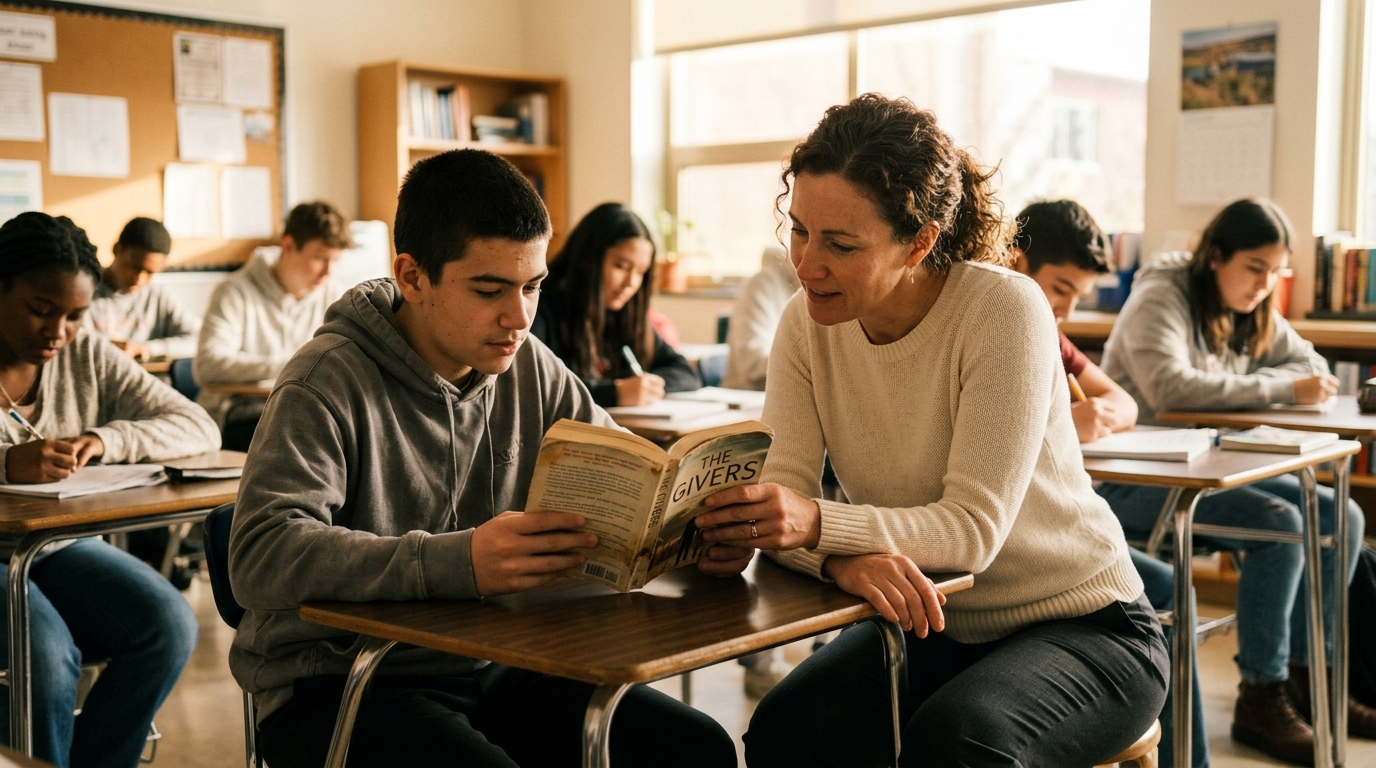
Secondary schools do not need a separate miracle program to improve reading. One practical place to start is the science lab, where claim-evidence-reasoning routines can strengthen comprehension, writing, and academic language for struggling readers.
Why the reading problem shows up in every classroom
By middle and high school, reading struggles are no longer confined to English class. They show up in science labs, social studies discussions, math word problems, and career-technical courses. Teachers see it every day: students who can talk intelligently about a topic but freeze when asked to read a dense passage, interpret a graph, or explain their thinking in writing.
The national picture is sobering. On the 2022 National Assessment of Educational Progress, often called the Nation’s Report Card, average reading scores fell for both fourth and eighth graders, and eighth-grade reading remained below pre-pandemic levels. That matters to secondary schools because students do not suddenly “catch up” when coursework gets more specialized. If anything, the literacy demands increase.
This is one reason science classrooms matter so much. Science is full of complex texts, precise vocabulary, data displays, and opportunities for argument. In other words, it is a powerful setting for teaching students how to read, think, and write in disciplined ways without turning science teachers into full-time reading interventionists.
CER is more than a writing frame
CER stands for Claim, Evidence, and Reasoning. Many secondary teachers already use it to structure lab conclusions or short written responses. At its best, though, CER is not just a writing template. It is a literacy routine that helps struggling readers make sense of what they read and observe.
A simple CER routine asks students to answer three questions:
- What is your claim?
- What evidence supports it?
- How does that evidence connect to the claim?
For proficient readers, those moves may seem obvious. For struggling readers, they are not. Students often copy a sentence from a text and call it evidence, or they make a claim with no support, or they list data without explaining its meaning. CER slows the thinking down. It gives students a repeatable structure for extracting meaning from text, visuals, and experiments.
This matters because adolescent literacy is not only about fluency. It is also about comprehension, vocabulary, background knowledge, and the ability to explain ideas clearly. CER touches all four.
Why science can be a literacy engine
Secondary literacy improves when students get repeated practice with reading in the disciplines, not just around them. Science texts ask students to do difficult things: track cause and effect, interpret technical language, compare explanations, and shift between prose, tables, diagrams, and data.
That challenge can become an advantage when instruction is structured well. Students who struggle with a whole chapter may still be able to read a short investigation prompt, annotate a graph, or pull one strong sentence of evidence from a paragraph. CER helps teachers break reading into manageable pieces.
Internationally, this idea aligns with what high-performing systems tend to value. On PISA, the OECD’s international assessment of 15-year-olds, top-performing education systems such as Singapore, Estonia, and Canada have generally emphasized knowledge-rich curricula, careful attention to language, and frequent student explanation rather than isolated test prep. The lesson is not that US schools should copy another country wholesale. It is that literacy grows when students regularly read, discuss, and justify ideas across subjects.
What CER does for struggling readers
First, CER gives students a purpose for reading. Instead of “Read pages 142–145,” the task becomes “Read to find evidence for whether increasing temperature changed the reaction rate.” A clear purpose improves attention and reduces the sense that reading is just endurance.
Second, CER supports vocabulary in context. Science terms become easier to learn when students must use them to make a claim and explain evidence. Words like variable, organism, density, or kinetic energy stop being definitions to memorize and become tools for thinking.
Third, CER strengthens sentence-level writing. Many struggling readers are also struggling writers. They benefit from oral rehearsal, sentence stems, and short constructed responses before they are asked to write full lab reports. A student who can say, “My claim is __ because the data show __” is building a bridge between speaking and academic writing.
Fourth, CER helps teachers spot where comprehension breaks down. If a student can state a claim but cannot find evidence, the problem may be reading the text or graph. If the student finds evidence but cannot explain it, the problem may be reasoning or background knowledge. That is useful diagnostic information in a busy classroom.
What gets in the way in real schools
Of course, none of this happens in ideal conditions. Secondary teachers face large classes, short periods, pressure to cover standards, uneven attendance, and students with a wide range of reading levels. Many science teachers were not trained as literacy specialists, and they should not be expected to fix years of reading difficulty on their own.
There is also the reality of time. A polished CER response takes longer than a worksheet of multiple-choice questions. Students may resist at first, especially if they are used to guessing or copying. Teachers may worry that scaffolds make tasks too easy, or that writing support slows down content learning.
But the more realistic comparison is not CER versus some perfect instructional model. It is CER versus the common pattern in which students complete labs without really understanding the texts, procedures, or conclusions. In that comparison, a short, well-designed CER routine is often a better use of class time.
How to make CER work for literacy, not just compliance
The strongest CER routines are explicit and consistent. Teachers model how to read a prompt, identify the question, gather evidence, and explain the logic. They do not assume students know what counts as evidence or how to move from observation to explanation.
This often means using smaller chunks. Instead of assigning a full-page conclusion, teachers can ask students to underline the claim in a sample response, sort possible pieces of evidence into strong and weak categories, or complete one reasoning sentence orally before writing.
It also helps to include multiple kinds of text. In science, “reading” may involve a paragraph, a lab setup diagram, a chart, and a data table. Struggling readers need guided practice moving among these sources. CER gives them a structure for doing that.
Feedback matters too. If every response gets a generic score, students do not learn much. If a teacher says, “Your evidence is accurate, but your reasoning does not explain why that evidence supports the claim,” the student knows what to revise. That kind of feedback is efficient because it is focused.
Concrete strategies schools can use now
Start small and repeat often. One CER paragraph a week in science is more realistic than a sudden overhaul of every lab report.
Use common sentence frames in grades 6–12, especially for multilingual learners and students reading below grade level. Frames such as “The data suggest __” or “This evidence supports the claim because __” reduce cognitive overload without lowering rigor.
Teach annotation for a purpose. Ask students to circle the question, box unfamiliar words, and highlight one sentence or data point that could serve as evidence.
Model thinking aloud. Show students how you decide whether a detail is relevant evidence or just interesting information.
Pair talk before writing. A 60-second partner rehearsal can improve the quality of written responses, especially for hesitant readers.
Use short, high-quality texts rather than assigning long passages with little support. Struggling readers often benefit more from close reading of a few paragraphs, a diagram, or a graph than from racing through pages they do not understand.
Coordinate across departments when possible. If science and social studies teachers use similar CER language, students get more repetitions and a clearer routine.
Protect intervention time for students who need more than classroom support. Strong content-area routines help, but some adolescents also need explicit reading instruction, fluency work, or vocabulary intervention beyond the science classroom.
Finally, keep expectations high and scaffolds humane. Students should do the intellectual work of science. They just need structures that help them read the task, find the evidence, and explain their thinking.
That is the promise of CER in secondary schools. It is not a magic cure, and it will not erase the effects of years of uneven literacy instruction overnight. But it is practical, content-rich, and doable in real classrooms. For many struggling readers, that kind of steady routine is exactly where progress begins.