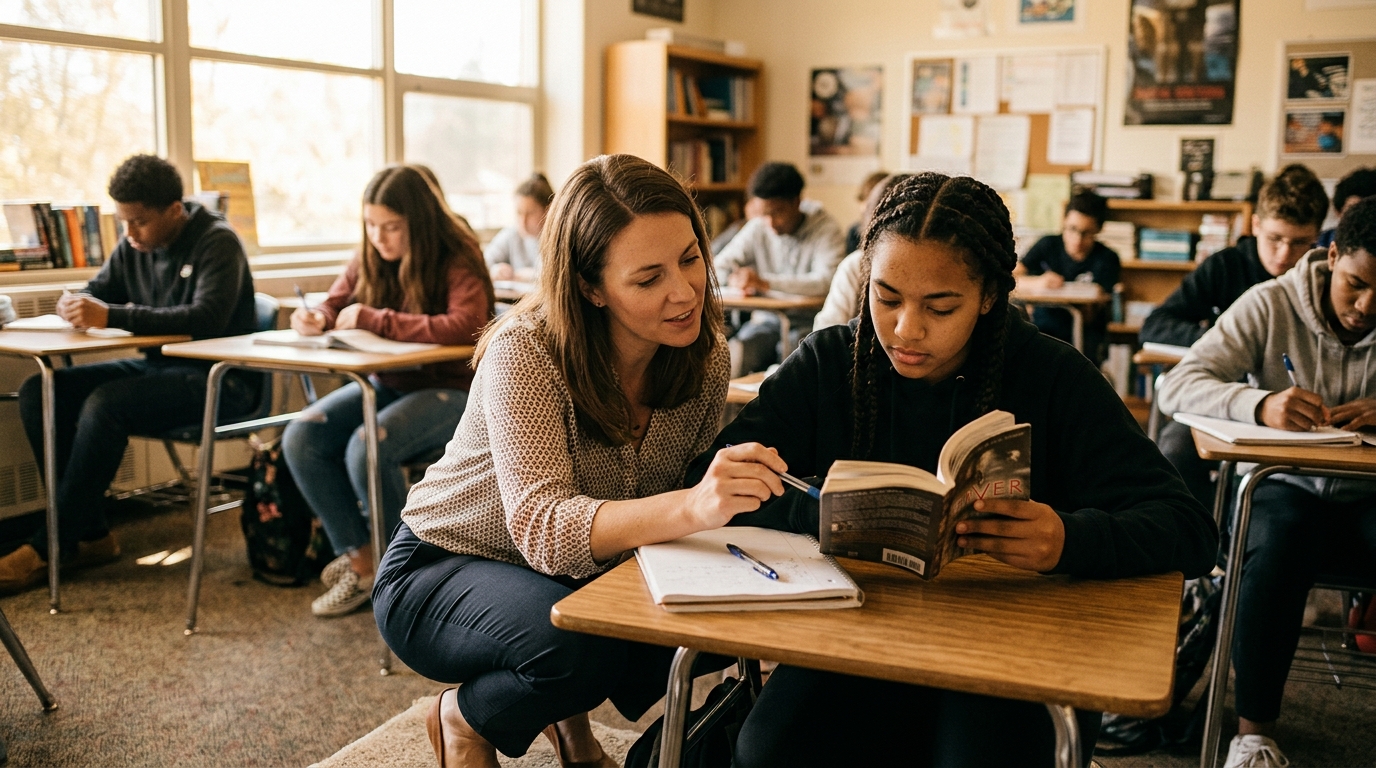
A short, repeatable start-of-class routine can strengthen reading comprehension by rebuilding the knowledge students need to make sense of complex texts. In secondary classrooms, a well-designed bell-ringer is one of the few literacy moves that is both high-leverage and realistic.
When secondary schools talk about raising literacy, the conversation often turns quickly to intervention blocks, new curricula, and test prep. Those matter. But one of the most practical literacy tools is smaller and quieter: the first five to eight minutes of class.
A strong bell-ringer can do more than settle students down. It can rebuild background knowledge, strengthen vocabulary, and give students repeated practice connecting what they already know to what they are about to read, discuss, or write. In grades 6-12, that matters because comprehension is not just about decoding words on a page. It is also about what readers bring with them.
That is one reason this work feels so urgent right now. On the 2022 NAEP, often called the Nation’s Report Card, average reading scores fell for both fourth and eighth graders, and eighth-grade reading was lower than it was in 1992, according to the National Center for Education Statistics. Teachers in middle and high school feel those effects every day: students can sound fluent in conversation yet struggle to make sense of a primary source, a science article, or a chapter from a novel.
The challenge is real, and so are the constraints. Secondary teachers often see 120 to 180 students a day. Class periods are short. Attendance can be uneven. Staffing and intervention time are limited. No one needs another grand initiative that collapses under real school conditions. What teachers do need are routines that are simple enough to sustain and strong enough to matter.
Why background knowledge matters so much
Reading comprehension depends partly on general and topic-specific knowledge. When students know more about a topic, they are better able to infer meaning, follow arguments, and remember what they read. This is not a theory most teachers need explained; they see it constantly. A student who knows something about Reconstruction, photosynthesis, or allegory can read more successfully in history, biology, or English.
Internationally, high-performing systems have long treated knowledge-building as part of literacy, not separate from it. Countries such as Singapore, Estonia, and Canada have posted strong reading performance on PISA, the Programme for International Student Assessment run by the OECD. Their approaches differ, but one shared lesson is clear: reading grows when schools consistently build academic knowledge and language across subjects.
In the United States, that cross-subject work is especially important in secondary grades. Literacy is not only the English department’s job. Students need support reading complex texts in science, social studies, the arts, career and technical education, and math. A bell-ringer can help every teacher contribute without turning every class into a reading intervention period.
The bell-ringer that works
The most effective bell-ringer for rebuilding background knowledge is not a random warm-up question or a copied definition. It is a brief, content-rich routine with three parts:
1. A short text, image, chart, quote, or vocabulary set tied to the day’s learning
2. Two to four questions that activate prior knowledge and add new knowledge
3. A fast written response that asks students to explain, infer, or connect
This matters because the routine does two jobs at once. It helps students enter the lesson calmly, and it feeds their comprehension before the main task begins.
For example, before reading about the Dust Bowl, students might see a photograph of a dust storm, read three sentences defining drought, erosion, and migration, and answer: What conditions made farming difficult? How might families respond? In six minutes, students have gained just enough knowledge to approach the larger text with more confidence.
In science, before a passage on ecosystems, students might study a simple food web and annotate two academic words: predator and biodiversity. In English, before reading a scene from Shakespeare, students might paraphrase a short proverb, define feud, and predict how conflict shapes character decisions. In each case, the bell-ringer is doing quiet comprehension work before students ever touch the central text.
Why this routine is especially powerful in grades 6-12
Secondary students are asked to read increasingly specialized material. That means they encounter dense vocabulary, assumed historical context, discipline-specific text structures, and references that are unfamiliar. When those gaps pile up, students can look disengaged when they are actually overwhelmed.
A knowledge-building bell-ringer lowers the barrier to entry. It gives students a foothold.
It also respects adolescent learners. Many older students do not want work that feels babyish or remedial. A well-crafted bell-ringer feels purposeful and age-appropriate because it is tied to real content, not stripped-down skill drills. Students are being prepared for the lesson, not pulled away from it.
There is also an equity benefit. Students come to school with different experiences and different exposure to academic language. A consistent routine helps level the field by making key context visible to everyone. That does not erase broader opportunity gaps, but it gives all students a fairer start with the day’s text.
What to include and what to avoid
The best bell-ringers are cumulative. They do not only preview today’s lesson; they also revisit yesterday’s and last week’s ideas. That spacing helps knowledge stick.
Strong ingredients include:
- Tier 2 and Tier 3 vocabulary students will meet in the lesson
- Short, accessible background information
- Images, maps, graphs, and timelines that carry meaning
- Quick retrieval questions from prior units
- Sentence stems that support explanation and academic language
What should teachers avoid? Activities that take too long, require extensive grading, or are only loosely connected to instruction. If the bell-ringer feels like filler, students know. If it creates a pile of paperwork, teachers will understandably stop using it.
The sweet spot is brief, predictable, and directly useful.
A realistic model for busy classrooms
Here is a routine many teachers can sustain:
Minute 1-2: Students enter and begin independently on a projected prompt or half-sheet.
Minute 3-4: Students read or examine the source and annotate one or two key details.
Minute 5-6: Students answer two short questions, one retrieval-based and one inference-based.
Minute 7-8: Teacher reviews responses, clarifies misconceptions, and bridges into the lesson.
That is enough. It does not need to be longer to be worthwhile.
Departments can make this easier by building shared banks of bell-ringers by unit. Coaches and leaders can help by protecting planning time and by not treating every strong routine as something that needs a new program name. The point is consistency, not branding.
What school leaders can do
If schools want routines like this to improve literacy, implementation matters.
First, leaders can define literacy broadly. Reading growth in secondary school depends on comprehension, vocabulary, fluency, motivation, and knowledge-building across content areas. Teachers need a clear message that literacy belongs in every classroom, with support that matches the expectation.
Second, leaders can use existing time wisely. A five-minute routine across multiple classes adds up to meaningful practice without requiring a new intervention block.
Third, leaders can provide practical examples, not just mandates. Show what a ninth-grade biology bell-ringer looks like. Show what works in algebra, world history, and English II. Teachers are more likely to adopt a routine when they can picture it in their own setting.
Finally, leaders can keep expectations humane. Teachers cannot produce perfect custom materials every day while managing large classes, behavior needs, and heavy grading loads. Shared resources and modest goals lead to stronger implementation than pressure alone.
Start small, stay consistent
The promise of this bell-ringer is not that it will single-handedly solve adolescent literacy. No five-minute routine can do that. But it can make complex reading more accessible, especially when used steadily over time.
For schools looking for realistic next steps, start here:
- Pick one course or department to pilot a common bell-ringer format for one unit.
- Keep each bell-ringer tied to a text students will read that day.
- Include one retrieval question and one background-building question.
- Teach and revisit key academic vocabulary.
- Review responses quickly and use them to shape instruction.
- Save the strongest examples so teachers are not starting from scratch next semester.
Literacy improvement in secondary school rarely comes from a single dramatic move. More often, it comes from many small, smart routines repeated well. A knowledge-building bell-ringer is one of those routines: affordable, adaptable, and grounded in what comprehension actually requires.
In a time when schools are being asked to do more with limited time and resources, that matters. Sometimes the fastest way to rebuild reading is not by adding one more initiative, but by making the first minutes of class count.