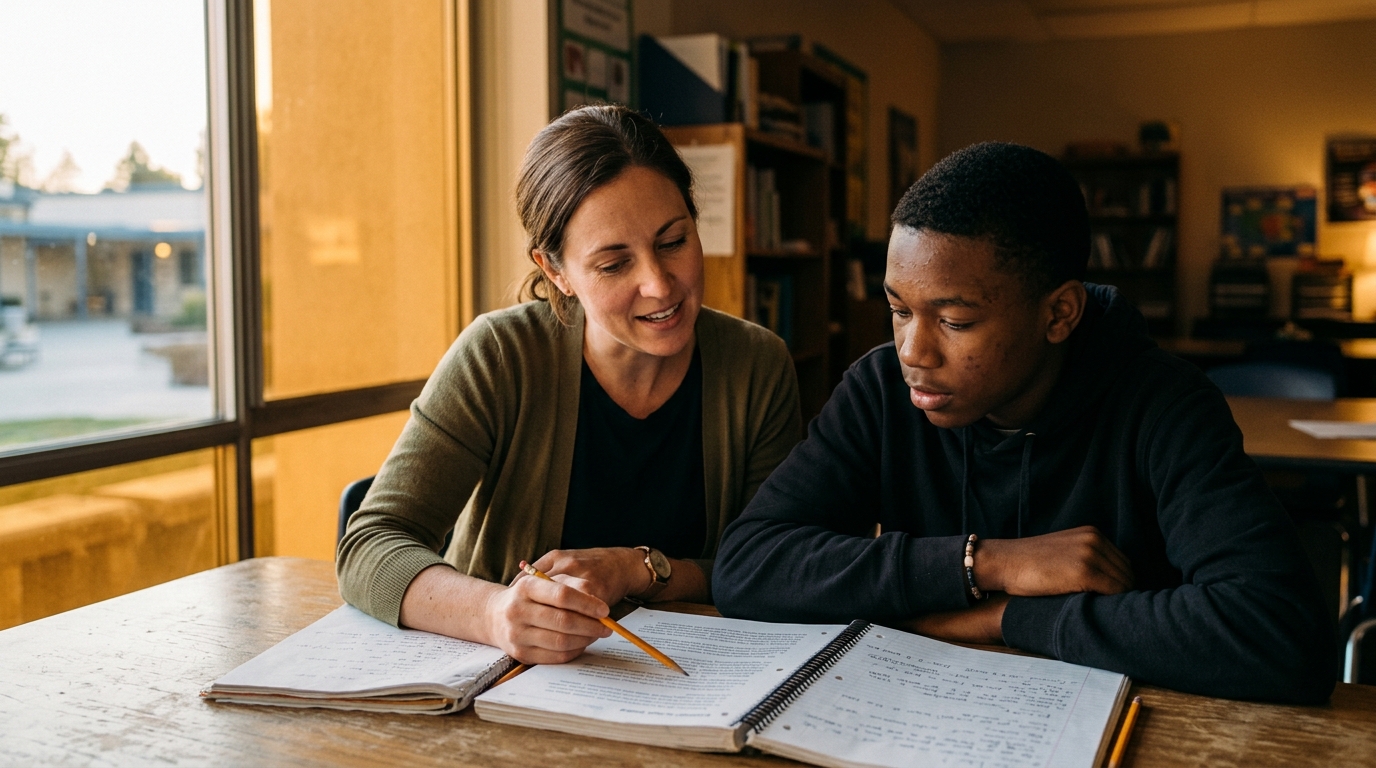
A simple pairing of one accessible text and one grade-level text can help adolescents rebuild stamina, vocabulary, and trust in themselves as readers. In secondary classrooms, this routine offers a realistic way to raise literacy without lowering expectations.
Teen reading confidence rarely collapses all at once. More often, it erodes quietly: a student stops volunteering to read aloud, skims instead of annotating, avoids longer passages, or decides that school reading is simply "not for me." By middle and high school, many students are carrying years of mixed messages about their ability as readers. They are expected to handle increasingly complex texts in science, history, English, and career courses, yet many are doing so with fragile fluency, limited academic vocabulary, or low stamina.
The numbers remind us that this is not a small problem. On the 2022 National Assessment of Educational Progress, often called the Nation’s Report Card, average reading scores fell for both fourth and eighth graders, and a large share of students performed below NAEP Proficient. Whatever debates exist about cut scores, the signal is clear: too many students are struggling to read complex material independently. By the time those students reach grades 6-12, teachers are not just teaching content. They are also managing the consequences of unfinished reading development.
That is why schools need routines that are practical, repeatable, and respectful of adolescent learners. One of the strongest is also one of the simplest: the two-text routine.
What the two-text routine is
The idea is straightforward. Students read two texts on the same topic, question, or theme:
1. one text that is highly accessible, and
2. one text that is closer to grade-level complexity.
The first text is not a "baby" version. It is a doorway. It builds background knowledge, introduces key vocabulary, and gives students enough confidence to approach the second text with purpose. The second text then stretches their comprehension, analysis, and evidence-based discussion.
In a history class, the accessible text might be a short article explaining the causes of the Great Migration in plain language, followed by a primary source letter or a more demanding historian’s account. In science, it could be a clear explainer on ecosystems followed by a denser textbook passage, data set, or research summary. In English, students might begin with a contemporary article about ambition before reading a scene from Macbeth.
The routine works because it does not confuse support with lowered expectations. Students still encounter complex text. They just do not meet it cold.
Why it helps struggling adolescent readers
Reading comprehension depends on more than decoding. It also relies heavily on background knowledge and vocabulary. This is one reason students often do better when they know something about a topic before reading about it in depth. The two-text routine deliberately supplies that foothold.
It also reduces the all-or-nothing feeling many teens have around reading. When the first text is manageable, students experience success early. That matters. Confidence is not fluff; it affects whether students persist when the second text gets hard.
Internationally, strong-performing systems have long treated literacy as a cross-curricular responsibility, not just an English department issue. Countries such as Estonia, Singapore, Canada, and Finland have drawn attention through PISA results over time, but their success is not built on magic programs. It is tied to coherent curriculum, strong teacher preparation, and steady attention to language, knowledge, and text across subjects. U.S. schools work in very different conditions, often with larger variation in funding and staffing, but the lesson still applies: adolescents get stronger readers when they read meaningfully in every class.
What this looks like in a real secondary classroom
A two-text lesson does not need elaborate materials or a full period every day. In fact, it is most useful when it becomes a dependable routine teachers can sustain.
Start with a focused question, not just a topic. For example: Why do societies migrate? How does power shape language? What makes a source trustworthy?
Then choose Text 1, the accessible entry point. This should be short enough to read successfully and rich enough to matter. Teachers can use a brief article, a transcript, a teacher-created overview, or a well-chosen excerpt. The goal is clarity, not oversimplification.
Before reading, preview three to five essential words students will meet again in Text 2. During reading, ask students to identify the central idea and one or two supporting details. Keep this part brisk. The first text is preparation, not the final destination.
Next comes Text 2, the more complex piece. Students now read with some prior knowledge, a few familiar terms, and a clearer sense of purpose. That changes the cognitive load. Instead of spending all their energy just figuring out what the passage is about, they can focus on how the author develops ideas, what evidence matters, and where confusion remains.
The discussion or writing task should require students to connect the texts. They might compare how each text presents the same issue, explain how Text 1 helped them understand Text 2, or use evidence from both to answer the lesson question.
Why this routine is realistic for busy schools
Teachers do not need another initiative that sounds promising in August and disappears by November. Secondary schools are juggling attendance challenges, schedule constraints, intervention demands, staffing shortages, and wide differences in student readiness. Any literacy strategy worth recommending has to fit real classrooms.
The two-text routine is realistic because it can be done once or twice a week, in any content area, with existing curriculum materials. It does not require a new course, a new testing platform, or a room full of leveled novels. It asks teachers to sequence access more thoughtfully.
It is also adaptable. English learners benefit from topic previews and repeated vocabulary. Students with reading difficulties benefit from an early win and reduced intimidation. Strong readers are not held back, because the second text still demands analysis and synthesis. In mixed-readiness classrooms, that matters.
Common mistakes to avoid
One mistake is making Text 1 so thin that it carries no real ideas. If the first text is just a watered-down summary, students may not gain enough knowledge to support deeper reading.
Another mistake is treating the second text as optional. The purpose is not to keep students in easier material. The purpose is to prepare them for complexity.
A third mistake is overloading the routine with too many tasks. If students annotate every line, answer ten comprehension questions, and complete a long graphic organizer for both texts, the routine becomes exhausting. Better to keep the reading moves focused and repeatable.
Finally, schools should avoid presenting this as a rescue strategy only for "low" readers. In reality, nearly all adolescents benefit from purposeful background building before tackling difficult text, especially in unfamiliar domains.
How school leaders can support it
If leaders want teachers to strengthen adolescent literacy, they have to protect the conditions that make it possible. That means giving departments time to choose paired texts together, identify essential vocabulary, and agree on a few shared reading routines. It also means resisting the temptation to demand a different literacy framework in every classroom.
A good starting point is one common expectation across grades 6-12: every student regularly reads an accessible text and a complex text on the same question, then writes or talks about the relationship between them. That is specific enough to guide practice and flexible enough to work in algebra support, biology, U.S. history, or English 10.
A practical starting plan
For teachers and schools ready to try this, start small:
Choose one unit next month, not the whole year.
Identify one challenging anchor text students usually struggle with.
Add one short, accessible text that builds the exact background knowledge students need.
Teach three to five words that appear across both texts.
Use one consistent response task, such as: How did Text 1 help you understand Text 2?
Track student confidence as well as correctness. Notice who reads longer, contributes more, or cites evidence more willingly.
The goal is not to make reading easy. The goal is to make success possible often enough that students begin to trust themselves again.
That trust matters. Adolescents who believe they can make sense of text are more likely to keep trying when reading gets hard. And in secondary school, where every subject depends on literacy, that may be the difference between compliance and genuine growth.
A well-chosen pair of texts will not solve every reading challenge facing grades 6-12. But it is a concrete, humane place to begin: one routine, two texts, and a better chance for students to see themselves as capable readers again.