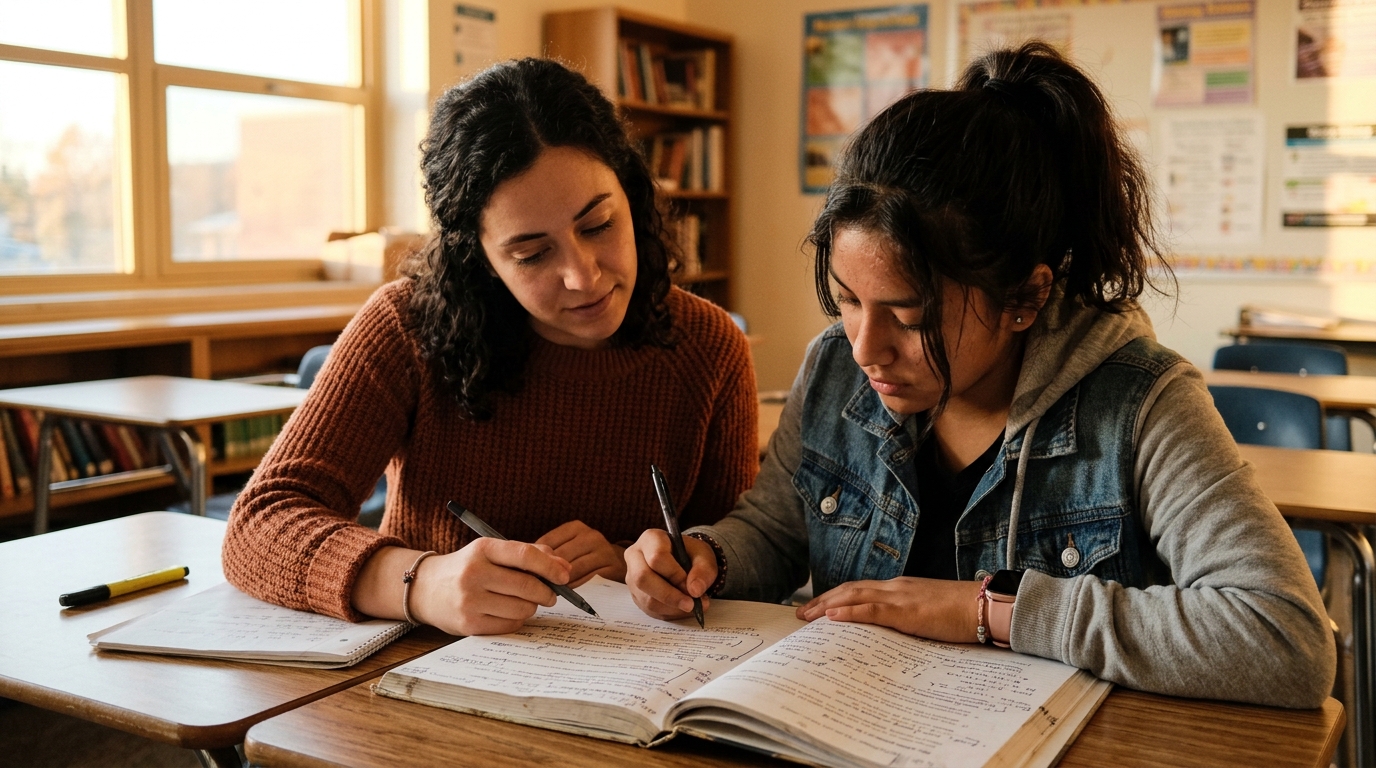
A stronger reading culture in secondary school does not always start with a new program. Sometimes it starts with a short, steady bellringer that helps ninth graders practice the kind of reading every class requires.
Ninth grade is where many reading struggles stop being private and start shaping a student's whole school day.
A student can get through middle school with decent effort, strong background knowledge, or generous supports. But high school asks for something different. Suddenly, students are expected to read a biology explanation, a primary source in history, a word problem in algebra, and a novel chapter in English—all in the same week. If reading is slow, fragile, or exhausting, everything else gets harder.
That is why a four-minute bellringer matters.
Not because it is magical. Not because it can replace intervention, tutoring, or strong core instruction. But because a short, predictable routine can give schools something they desperately need: a realistic way to build reading stamina and comprehension without blowing up the schedule.
Why ninth grade needs a reset
The reading picture for American adolescents is sobering. On the 2022 National Assessment of Educational Progress, average reading scores fell for both 8th and 12th graders, continuing a long pattern of concern and widening gaps. NAEP also showed that many students are not reading at proficient levels, especially students from historically underserved groups.
Teachers do not need a federal test to tell them this. They see it when students avoid reading directions, skim instead of process, or freeze when asked to explain what a text means. They see it when students can decode many words but cannot hold onto meaning across a paragraph, let alone a page.
And they see the reality behind the data: bigger classes, interrupted learning, chronic absenteeism, limited intervention staff, and a crowded high school schedule where every minute is already spoken for.
So the question is not, “What is the ideal literacy plan in a perfect system?” The better question is, “What can a real secondary school start doing tomorrow, with the staff and minutes it already has?”
The case for a four-minute bellringer
A short reading bellringer works because it lowers the barrier to consistency.
In many secondary schools, the hardest part of literacy improvement is not knowing what good practice looks like. It is finding a structure teachers can actually sustain across weeks and months. A four-minute routine is small enough to protect and strong enough to matter if it happens daily.
Think of it as a reading reset, not a reading cure.
Done well, a bellringer can help students practice three things adolescents often need:
- reading a short, grade-appropriate passage with attention
- retrieving meaning from the text, not just reacting to it
- writing or speaking briefly about what they understood
That is the kind of work students need in every subject.
High-performing systems internationally often emphasize exactly this kind of steady literacy practice. Countries such as Estonia, Singapore, and Canada have posted strong reading performance on PISA, the Programme for International Student Assessment run by the OECD. Their success is not about gimmicks. It is tied to coherent curriculum, strong teacher preparation, and regular engagement with complex text. American schools may not be able to import another country's system, but they can learn from the principle: reading improves when students read, think, and discuss meaning often.
What the bellringer actually looks like
The strongest version is simple and repeatable.
For four minutes at the start of class, students read a short passage and respond to one text-based prompt. The passage might be 75 to 150 words, depending on students' needs and the subject area. The key is that it is worth reading closely.
A classroom routine might look like this:
Minute 1: Students read silently, pencil in hand.
Minute 2: Students reread one sentence, underline a key phrase, or circle an unfamiliar word from context.
Minute 3: Students answer one question in writing.
Minute 4: Quick turn-and-talk or teacher cold call using sentence stems.
The prompt should stay close to comprehension, such as:
- What is the author's main point?
- Which word or phrase best shows the speaker's attitude?
- What does this sentence suggest about the character, process, or event?
- Which detail best supports the central idea?
This is not busywork. It is repeated practice in extracting meaning from text.
Why this works in secondary classrooms
First, it is efficient. Teachers do not need to redesign an entire unit. They need one short passage and one good question.
Second, it is cross-curricular. Literacy is not only the English department's job because reading demands do not live only in English class. Science teachers can use lab procedures or short explanatory texts. Social studies teachers can use speeches, maps, or primary-source excerpts. Career and technical education teachers can use manuals, case notes, or workplace scenarios.
Third, it is psychologically safer for students. Many teenagers who struggle with reading have learned to protect themselves by opting out. A short text is less threatening than a chapter. Four minutes feels survivable, especially when the routine is predictable and the teacher normalizes trying again.
Fourth, it builds background knowledge over time. Reading comprehension is not a generic skill floating in the air. It depends partly on what students know. When bellringers connect to course content, students strengthen both literacy and understanding of the subject.
What it cannot do on its own
It is important to say this plainly: a bellringer will not solve severe reading difficulties.
Students with significant decoding gaps, language-based learning disabilities, or years of interrupted literacy development need more than a classroom warm-up. They may need diagnostic assessment, explicit foundational skills instruction, intensive intervention, speech-language support, or structured tutoring.
Secondary teachers also need support. It is unreasonable to tell content-area teachers to "teach reading" with no training, no planning time, and no useful materials. If school leaders want literacy to improve, they have to make the work doable.
That means protecting common routines, giving teachers shared passage banks or question stems, and avoiding the trap of launching one more initiative with no follow-through.
How schools can make it realistic
The schools that make this work usually make three smart decisions.
First, they standardize the structure, not the script. Every teacher can start class with a short read-and-respond routine, but the texts should fit the course.
Second, they keep the prep load light. Departments can build a shared bank of short passages tied to current units so no one is creating everything alone.
Third, they use the responses formatively. Bellringers are most useful when they show teachers what students understood today, not when they become another stack of grades.
This matters in schools where teachers are already stretched thin. A routine that requires heavy grading will collapse. A routine that gives quick insight into comprehension is much more likely to last.
Five concrete moves to start next week
1. Pick one routine and keep it for six weeks.
Do not keep changing the format. Students who struggle with reading benefit from predictability.
2. Use short texts with one worthwhile question.
Resist the urge to assign too much. A smaller amount of real thinking beats a longer passage students never process.
3. Teach two or three discussion stems.
Simple stems like “The text suggests…,” “A key detail is…,” and “I know this because…” help students turn reading into evidence-based talk.
4. Build in one reread.
Adolescents often think good readers understand everything on the first pass. A bellringer can quietly teach the opposite: strong readers reread to make meaning.
5. Track growth in low-pressure ways.
Save a sample once every two weeks. Look for stronger written responses, better use of evidence, and more accurate summaries. Small gains matter.
A small start that respects reality
There is no honest way to talk about adolescent literacy without acknowledging how hard this work is. Secondary schools are being asked to accelerate learning, support mental health, manage attendance challenges, and prepare students for college, careers, and civic life—all at once.
Still, students need more chances to read successfully during the school day, not fewer.
A four-minute bellringer is not a headline-grabbing reform. It is quieter than that. But in many schools, quiet routines are exactly what hold improvement together. They create repetition without drama, support without stigma, and practice without stealing the whole period.
For ninth graders, that can be enough to start a reset.
Not all at once. Not perfectly. But one short text, one careful question, and one more daily chance to make meaning from words on a page.
Enjoyed this? Get the next articles straight to your inbox — join the free newsletter at https://juliusmason.com/blog. Practical reads, no spam, unsubscribe anytime.