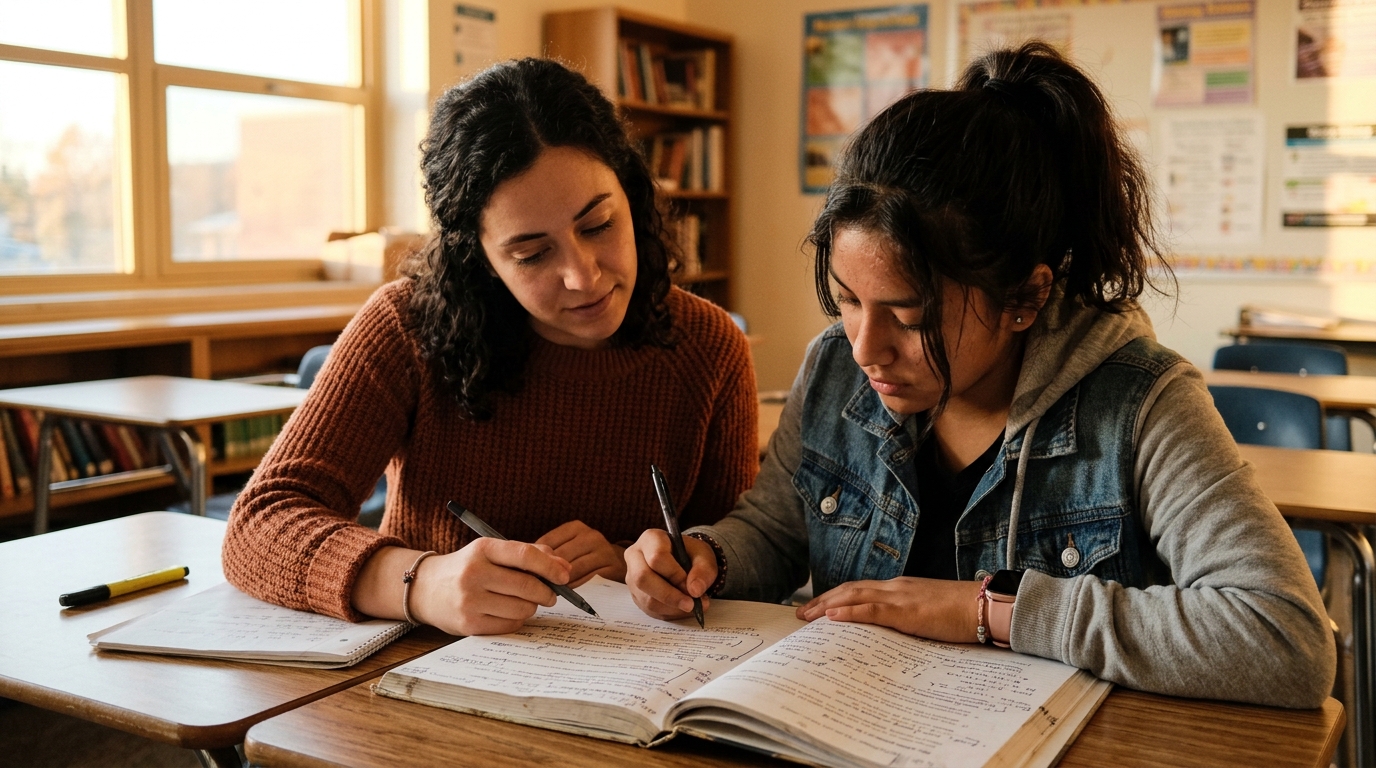
A simple bilingual annotation routine can help adolescents make sense of complex texts without lowering expectations. In grades 6–12, it offers a practical way to build comprehension, vocabulary, and confidence—especially for multilingual learners and students who have learned to hide when reading gets hard.
Secondary teachers know the feeling: a class opens a demanding article, chapter, or primary source, and within minutes the room splits. A few students dive in. Some skim. Others stare at the page and wait for someone else to explain it.
That is not a motivation problem alone. It is often a language-and-access problem.
In the United States, reading achievement remains a serious challenge. On the 2022 NAEP reading assessment, average scores fell for both fourth and eighth graders, and only about 31% of eighth graders scored at or above Proficient, according to the National Center for Education Statistics. By secondary school, those gaps show up everywhere: in science labs, social studies seminars, CTE courses, and math word problems—not just in English class.
For multilingual learners, the challenge can be even sharper. They may have strong ideas, background knowledge, and oral language in one or more languages, yet still struggle to process dense academic English quickly enough to keep up. Too often, schools respond by simplifying texts so much that students lose the opportunity to do real intellectual work.
There is a better middle path: keep the complex text, but change the routine. One powerful approach is the bilingual annotation routine.
What bilingual annotation actually is
Bilingual annotation is exactly what it sounds like: students interact with a text using two languages when helpful. They might underline a key sentence in English, jot a margin note in Spanish, Arabic, Haitian Creole, or Vietnamese, circle an unfamiliar word, translate only that word or phrase, and then write a brief summary in English.
The point is not to translate every line. The point is to use a student’s full language repertoire to unlock meaning.
In practice, the routine can work for students who are officially identified as English learners, for former English learners, for heritage speakers with stronger oral than written skills in another language, and even for monolingual English speakers who benefit from structured annotation moves. Good literacy routines help more students than the target group.
This approach aligns with a simple truth teachers see every day: comprehension improves when students actively process text. Annotation slows reading down just enough to make thinking visible. The bilingual piece adds access without removing rigor.
Why it matters in grades 6–12
Secondary texts are unforgiving. Sentences get longer. Vocabulary becomes more abstract. Authors assume background knowledge students may not have. In middle and high school, many students stop asking for help because they do not want to look behind.
That matters because adolescent literacy is the gateway to nearly everything else. A student who cannot independently make sense of a history document, a lab procedure, or a persuasive essay prompt is locked out of learning even when they are capable of the underlying ideas.
Internationally, high-performing systems tend to treat literacy as a whole-school responsibility, not a siloed subject. Countries such as Canada, Estonia, Finland, and Singapore are often cited in discussions of strong reading outcomes on PISA, administered by the OECD. Their contexts differ from those in the United States, and no international comparison transfers neatly. But one lesson is consistent: students do better when language development is woven into content learning and when teachers use structured supports rather than waiting for reading difficulties to solve themselves.
What the routine looks like in a real classroom
The best version of bilingual annotation is predictable, brief, and repeatable. It does not require a full class period or a perfect one-to-one translation of every text.
A teacher might teach students five simple annotation moves:
1. Star the central idea.
2. Circle unfamiliar or important words.
3. Write a quick margin note: “This means…”
4. Mark confusion with a question mark.
5. Summarize the paragraph in one sentence.
Now add the bilingual layer: students may complete margin notes, quick definitions, or paragraph summaries in their home language first, then restate key ideas in English. Or they may annotate in English and use their home language only when meaning breaks down. Teachers can decide when English output is required and when multilingual processing is the support.
For example, in a 9th grade biology class reading about photosynthesis, a student might label “chloroplast” in English, note in Spanish that it is “where the plant makes food,” then write an English sentence using the academic term. In 7th grade social studies, a student might paraphrase a difficult sentence from a primary source in Arabic before discussing it in English with a partner.
That is not a shortcut. It is disciplined comprehension work.
Why it works
First, it reduces cognitive overload. Students reading a complex text are juggling decoding, vocabulary, syntax, background knowledge, and attention. Allowing strategic use of another language can free up working memory for actual thinking.
Second, it strengthens vocabulary. Students are more likely to remember a new academic word if they connect it to a concept they already understand. A quick bilingual note can be the bridge.
Third, it increases participation. Students who might stay silent during whole-class reading often have more to say once they have processed the text in writing.
Fourth, it preserves dignity. Adolescents do not want to be handed babyish materials. They want support that helps them succeed with age-appropriate content.
Common concerns—and fair answers
Some teachers worry that students will rely too heavily on translation. That can happen if the routine is not structured. The answer is not to ban bilingual processing; it is to give it clear limits. Annotate in either language, but discuss the claim in English. Translate only key words, not entire pages. Use home language to gain entry, then move toward English production.
Others worry about time. This concern is real. Secondary pacing guides are packed, and teachers are already asked to do too much. But the routine does not have to be elaborate. Even seven focused minutes before discussion can improve the quality of what follows. In many classrooms, it saves time because students need fewer rescue explanations later.
Some schools also worry about staffing and teacher preparation. Not every teacher speaks students’ home languages. That is okay. Teachers do not need to be bilingual to run a bilingual annotation routine. They need norms, sentence frames, a short list of annotation moves, and permission for students to use multilingual tools appropriately.
How to start without overwhelming staff
School improvement succeeds when it is realistic. Here are practical ways to begin:
Start with one text structure
Pick one routine for all departments: annotate claims and evidence, or annotate cause and effect, or annotate unknown vocabulary plus summary. Consistency helps students and reduces training demands.
Keep the annotation code simple
Use the same 4–5 symbols schoolwide if possible. Too many codes create compliance instead of comprehension.
Allow strategic home-language use
Tell students exactly when they may use another language: for quick paraphrases, vocabulary notes, and first-draft summaries. Make the purpose comprehension, not word-for-word translation.
Require visible thinking
Collect annotated texts occasionally, not to grade every mark, but to see whether students are identifying key ideas, confusion points, and vocabulary.
Pair annotation with short talk
After reading, ask students to compare one annotation with a partner. The writing prepares the speaking; the speaking deepens the writing.
Use technology carefully
Translation tools and bilingual glossaries can help, especially when staffing is thin. But students still need to think about meaning, not just paste text into an app. Keep the human routine at the center.
Train across content areas
Science, history, English, and CTE teachers all teach reading in their own way. A short shared professional learning cycle can help staff adapt the same routine to different texts instead of inventing separate systems.
Measure what matters
Look for better discussion, stronger written summaries, fewer blank stares at the page, and gradual improvement in students’ ability to explain complex ideas in English. Standardized scores matter, but daily access matters too.
A final word
Schools do not need one more silver bullet. They need routines that respect both the complexity of literacy and the realities of classrooms.
The bilingual annotation routine is not flashy. It will not erase every reading gap, and it cannot substitute for strong curriculum, intervention, and sustained support. But it can do something important right away: help more students enter the text, stay with the text, and leave the text with understanding.
In a time when so many adolescents have learned to fake reading or fear it, that is no small thing. Give them a pencil, a few smart moves, and permission to think in more than one language. You may be surprised by how much they were ready to say all along.