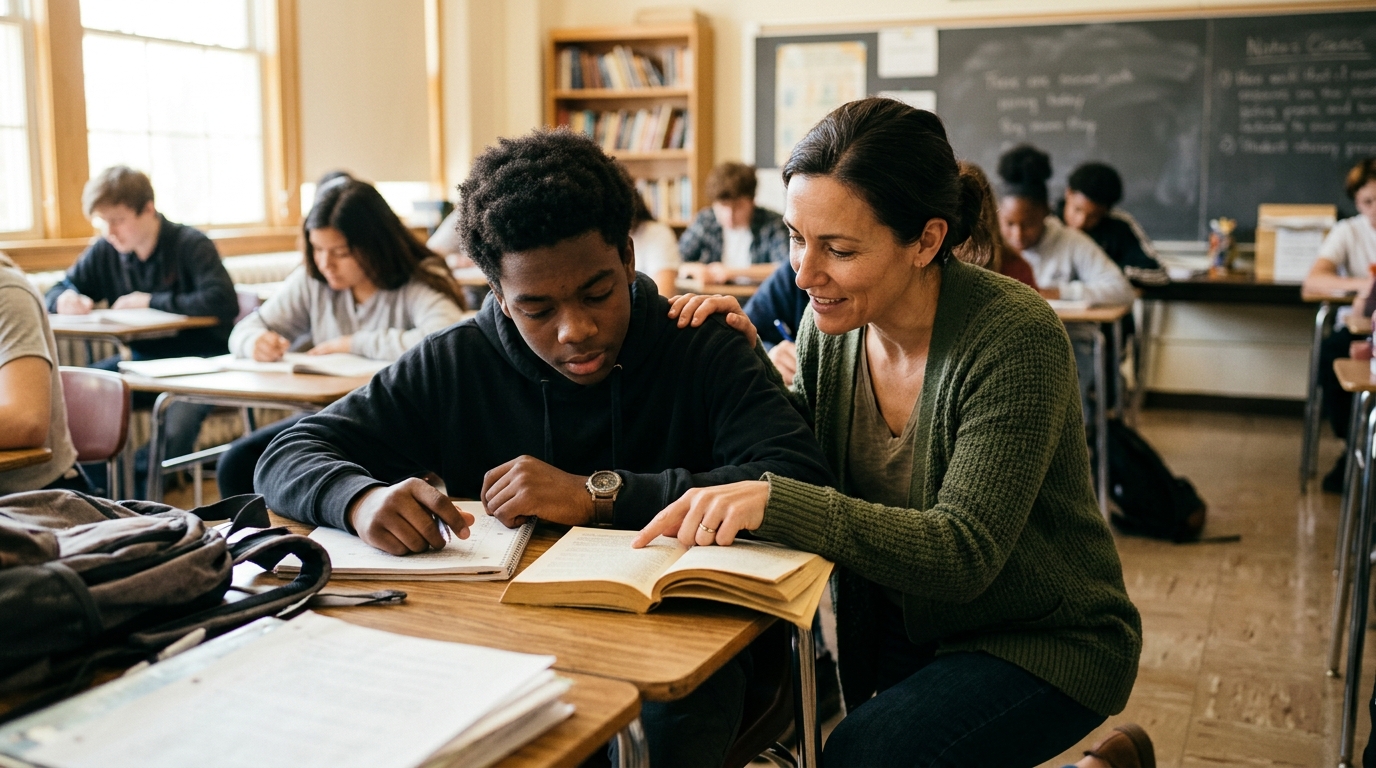
The science of reading does not end in 5th grade. In middle and high school, the work shifts from learning to read to reading to learn—while still teaching the vocabulary, background knowledge, fluency, and comprehension many students need.
The conversation changes after 5th grade
In elementary school, the science of reading usually centers on foundational skills: phonemic awareness, phonics, decoding, fluency, vocabulary, and comprehension. By middle and high school, some people assume that work is finished. It is not.
What changes in grades 6–12 is the profile of student need and the daily reality of school. Secondary students are expected to learn from increasingly complex texts in English, science, history, career and technical courses, and electives. At the same time, many adolescents still need direct support with fluency, vocabulary, morphology, syntax, comprehension, and even decoding. The science of reading still matters; it just looks different.
This matters because the literacy challenge is real. On the 2024 NAEP, often called the Nation’s Report Card, average reading scores remained below pre-pandemic levels, and only about 30% of eighth graders performed at or above Proficient in reading. Those numbers do not describe individual potential, but they do remind us that many students enter secondary school needing more help than their schedules are designed to provide.
Secondary literacy is not elementary literacy scaled up
Adolescent readers face a different kind of demand. Texts become denser, sentences longer, vocabulary more abstract, and assumptions about background knowledge much higher. A student might decode reasonably well and still struggle to understand a biology chapter, a primary source document, or a geometry explanation.
That is why secondary literacy improvement cannot be reduced to one program or one intervention block. It requires attention to several strands at once.
First, some students still need foundational support. Older struggling readers are not helped by pretending they have already mastered the basics. If assessment shows gaps in decoding, word recognition, or fluency, those gaps need explicit instruction—delivered in age-respectful ways.
Second, nearly all secondary students benefit from systematic work in academic vocabulary, morphology, and language structures. Prefixes, suffixes, roots, Greek and Latin forms, and the way sentences carry meaning across clauses matter enormously in grades 6–12.
Third, comprehension becomes more discipline-specific. Reading like a historian is not the same as reading like a scientist. Students need explicit teaching in how to interpret evidence, track claims, read charts and diagrams, and question sources.
What the science of reading means in grades 6–12
The science of reading is not a script. It is a body of evidence from cognitive psychology, linguistics, neuroscience, and education about how reading develops and how it can be taught. In secondary settings, that evidence points to a few durable truths.
Skilled reading depends on automatic word recognition and language comprehension. This idea, often described through the Simple View of Reading, still applies to adolescents. If either side is weak, reading suffers.
Background knowledge matters. Students understand more when they know more. This is one reason literacy cannot belong only to the English department. Knowledge built in science, social studies, the arts, and CTE supports reading growth.
Vocabulary grows through both direct instruction and wide, supported reading. Older students need repeated encounters with important academic words in meaningful contexts.
Fluency still matters. Not because speed is the goal, but because accurate, expressive, reasonably automatic reading frees up attention for thinking.
Comprehension strategies help most when they are taught briefly, modeled clearly, and applied to real content—not when they become endless worksheets about “finding the main idea” detached from knowledge.
Why this is hard in real schools
Secondary schools are working against real constraints. Class periods are short. Teachers are responsible for content standards, course credits, tests, labs, projects, and behavior support. Schedules leave little room for intervention. Staffing shortages make small-group instruction difficult. Many schools also serve students with interrupted schooling, multilingual learners, and teenagers who have learned to hide their reading difficulties well.
There is also a structural issue: middle and high schools are organized by subject specialization. That is a strength for content expertise, but it can make literacy feel like someone else’s job. English teachers cannot carry the full weight alone, and content teachers should not be expected to become reading specialists overnight.
Another challenge is motivation. Adolescents are acutely aware of status. If support feels childish or public, many will resist it. Secondary literacy work has to protect dignity.
What we can learn from stronger systems
International comparisons should be used carefully. No country offers a plug-and-play model for the United States, and demographics, funding systems, and social supports differ. Still, large-scale assessments such as PISA have shown that some systems, including Singapore, Estonia, Canada, and Finland, have often performed comparatively well in reading over time.
The useful lesson is not that these places found a miracle method. It is that stronger outcomes tend to be associated with coherence: solid teacher preparation, a knowledge-rich curriculum, attention to language development, timely intervention, and less fragmentation between literacy and content learning.
In other words, improvement in adolescent literacy usually comes from doing ordinary things well and consistently, not from chasing novelty.
What effective secondary literacy support looks like
Start with better diagnosis. Secondary schools need assessment systems that go beyond a single reading score. Teachers need to know whether a student’s main barrier is decoding, fluency, vocabulary, background knowledge, comprehension, attendance, or some combination of these.
Provide targeted intervention for students with significant gaps. Some older students need explicit, systematic instruction in decoding and encoding. That should be intensive, scheduled, and taught by trained staff. If we skip this step, many students remain stuck.
Teach vocabulary and morphology across subjects. Science teachers can teach the meaning of domain-specific terms and word parts. History teachers can unpack the language of argument and causation. Math teachers can make explicit the language of comparison, proof, and procedure.
Make text structure visible. Secondary students benefit when teachers model how a lab report, textbook chapter, historical argument, or technical manual is organized and how readers should approach it.
Use reading routines that support thinking. Short annotation protocols, text-dependent discussion, sentence unpacking, and summarization can help, especially when used consistently and tied to meaningful content.
Increase access to complex text with support, not avoidance. Students do not grow by reading only simplified material. They need scaffolds such as read-alouds, chunked passages, guided questions, vocabulary preview, and partner discussion.
Protect time for actual reading. Independent reading alone is not enough, but volume matters. Students need time to read whole texts, not only excerpts and slides.
Realistic next steps for schools
Schools do not need to overhaul everything at once. A practical starting point is to build a shared understanding that literacy is a grades 6–12 responsibility.
Then choose a few high-leverage moves:
Adopt a common screening and diagnostic process for struggling readers.
Create intervention pathways for students with foundational skill gaps, including older students who still need decoding support.
Train all teachers in a small set of disciplinary literacy practices they can use without losing their subject identity.
Audit the curriculum for vocabulary load, background knowledge demands, and text complexity.
Give departments time to plan how reading, discussion, and writing will support learning in their courses.
Track whether students are actually getting more successful reading practice, not just more assignments.
The science of reading after elementary school is not about importing an elementary model into middle and high school. It is about recognizing that adolescent literacy is both a reading issue and a systems issue. Students need explicit teaching, rich knowledge, thoughtful intervention, and dignified support. Teachers need training, time, and tools that fit the reality of secondary classrooms.
That is not a simple fix. But it is a hopeful one. When schools treat literacy as a shared responsibility and respond to student needs precisely, reading improvement in grades 6–12 becomes much more possible.