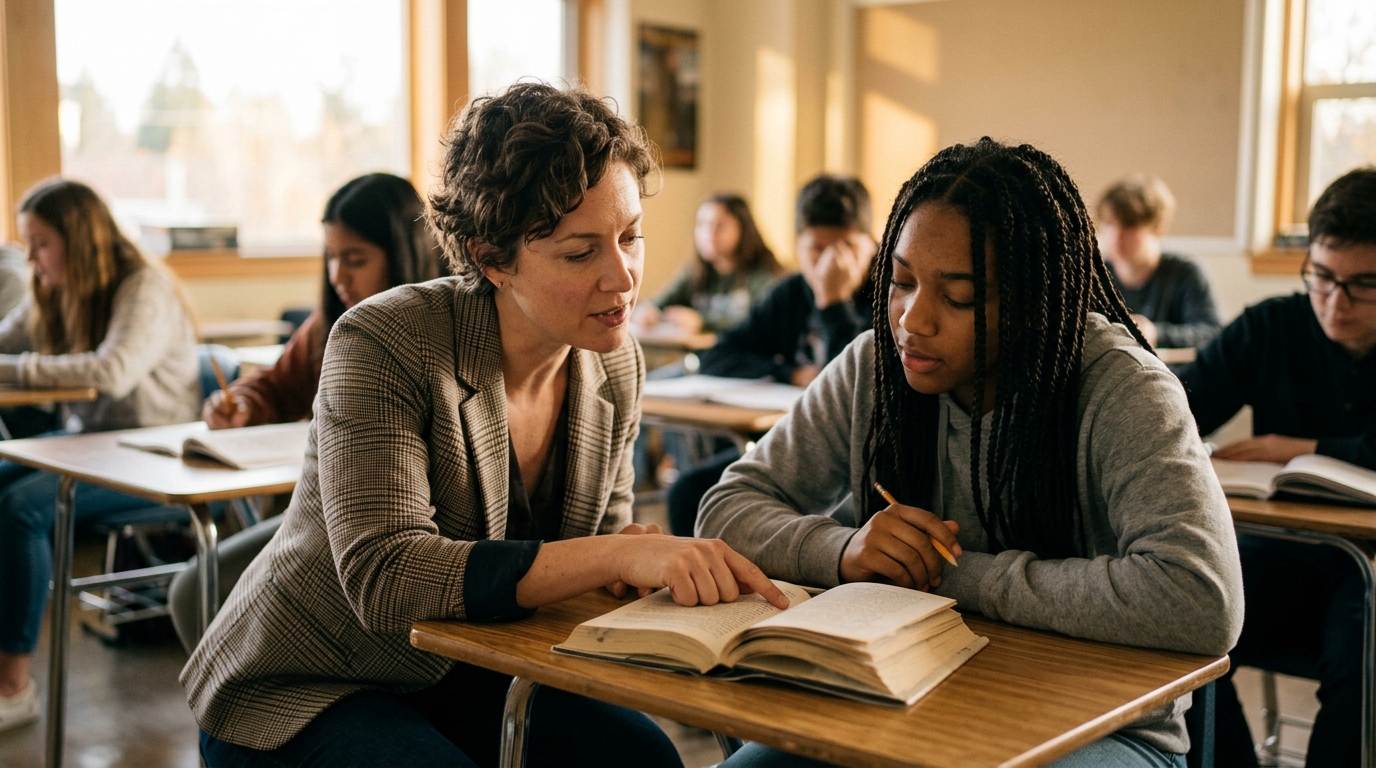
Many adolescents struggle with reading not because they are lazy or incapable, but because they have lived through years of uneven instruction, limited support, and widening opportunity gaps. Secondary schools can help—but only when we understand the problem clearly and respond realistically.
For many middle and high school students, reading is not a simple school task. It is a daily reminder of struggle. A teenager who reads below grade level may be asked to analyze a historical speech, explain a science article, and write from evidence across the school day—all while still working to decode complex words, build vocabulary, or hold meaning together across a long text.
That gap is real, and it matters. But the most important truth is this: it is not the student’s fault.
When adolescents have weak reading skills, the causes usually began years earlier and were shaped by systems, opportunities, and circumstances far beyond any one child’s control. If we want to improve literacy in grades 6–12, we have to start from that human truth rather than from blame.
The numbers are worrying, but they need context
National results show why so many educators are concerned. On the 2024 National Assessment of Educational Progress, often called the Nation’s Report Card, average reading scores remained below pre-pandemic levels for both fourth and eighth graders. NAEP also reported that a large share of students performed below the NAEP Proficient level in reading. These scores do not tell us everything about a child, but they do show that many students are not reading with the confidence and complexity school demands.
International measures tell a similar story. The 2022 Programme for International Student Assessment, or PISA, found that reading performance declined in many countries after the pandemic disruptions. That matters because this is not just an American problem. Across systems, educators are dealing with interrupted learning, rising absenteeism, widening inequality, and the challenge of helping older students read increasingly complex academic texts.
Still, context matters. “Below grade level” can hide enormous differences. Some students struggle mainly with fluency. Others can read the words but have limited vocabulary or background knowledge, which makes comprehension much harder. Some multilingual learners are building English while also learning grade-level content. Some students with dyslexia or other learning differences were not identified early enough. One label cannot capture all of that.
Most reading problems start early—but show up loudly in secondary school
By the time students reach middle school, reading difficulties are often years in the making. If foundational skills were shaky in the primary grades, the problem does not disappear with age. It becomes more visible.
That is because secondary school changes the reading demand dramatically. In elementary school, students are still learning to read. In secondary school, they are expected to read to learn in every subject. Texts become denser, sentences become more complex, and vocabulary becomes more specialized. A student may seem “fine” until sixth or seventh grade, when the curriculum stops forgiving weak comprehension.
This is one reason teenagers are often misjudged. Adults may assume that an older student who avoids reading is unmotivated. In reality, many adolescents are protecting themselves from embarrassment. They have learned, sometimes for years, that reading in front of peers can expose them. Avoidance can look like apathy, but it is often self-defense.
The causes are bigger than individual effort
It is comforting to believe literacy is mainly about effort: if students just tried harder, read more, or spent less time on phones, the problem would solve itself. Real life is not that simple.
Students’ reading development is shaped by access to books, preschool experiences, attendance, health, housing stability, language exposure, and whether they received effective instruction in the early grades. Poverty does not determine destiny, but it does affect opportunity. So do underfunded schools, large class sizes, shortages of reading specialists, and limited intervention time.
The pandemic intensified many of these pressures. School closures and disruptions affected students unevenly, and those who were already vulnerable often lost the most. Chronic absenteeism has also remained a major challenge in many districts, making steady literacy support even harder.
There is also the issue of curriculum and training. For years, many schools did not consistently use reading instruction aligned with what research says about decoding, fluency, vocabulary, background knowledge, and comprehension. That does not mean teachers failed. It means many educators were asked to do extraordinarily important work without consistent preparation, materials, or time.
Why secondary teachers face such a difficult job
Improving literacy in grades 6–12 is hard because secondary schools were not designed mainly as reading intervention systems. A seventh-grade science teacher may have 150 students and 50 minutes per class. A high school history teacher may be expected to cover vast content standards before state exams. An English teacher may have students reading anywhere from third-grade to twelfth-grade levels in the same room.
That is not a lack of caring. It is a design challenge.
Secondary teachers are content specialists, yet many are now being asked to address significant reading gaps at the same time they teach algebra, biology, civics, or literature. Without training, planning time, and strong materials, that work can feel impossible. Schools also face difficult scheduling tradeoffs: if a student receives reading intervention, what class do they miss? Electives? World language? Support periods that are already overfull?
This is why quick-fix promises are so unhelpful. There is no assembly, app, or one-semester program that can erase years of missed instruction.
What higher-performing systems can teach us
Countries such as Estonia, Singapore, Canada, and Finland are often discussed in literacy conversations because of strong international performance, including on PISA. Their contexts differ from the United States, so simple copying does not work. But some broad lessons are useful.
High-performing systems tend to invest in teacher preparation, coherent curriculum, and early support before students fall far behind. They are generally more likely to treat literacy as a shared responsibility across the system rather than as the problem of one classroom teacher. In many strong systems, struggling readers are identified earlier, and interventions are better integrated into the school structure.
That does not mean those countries have no challenges. It means they remind us that literacy gains usually come from long-term coherence, not panic-driven reform.
What schools can do now—realistically
The good news is that adolescents can improve as readers. Older students are not “too late.” But schools need practical strategies that fit real constraints.
First, schools can strengthen Tier 1 instruction across subjects. Reading support should not live only in English class. Teachers in history, science, and other disciplines can explicitly teach the vocabulary, sentence structures, and text features of their fields. That is not lowering standards; it is giving students access to them.
Second, schools can provide targeted intervention for students with the greatest needs. Intensive support works best when it is regular, skill-based, and delivered by trained staff. For some students, that means foundational decoding and fluency work even in middle or high school. For others, it means comprehension, vocabulary, and language development.
Third, districts can use high-quality screening and diagnostic data wisely. A universal screener alone is not enough, but schools do need a clearer picture of whether students are struggling with word recognition, fluency, language comprehension, or all three. Better diagnosis leads to better support.
Fourth, protect time for reading. Silent reading by itself is not a full intervention, but students do need sustained time with texts they can actually read and discuss. In many schools, independent reading disappears just when students need it most.
Fifth, invest in teacher learning that respects teachers’ time and expertise. Professional development should be specific, practical, and tied to curriculum and student work. Teachers are more likely to change practice when support is ongoing and usable, not when it arrives as a one-day mandate.
Finally, schools should communicate with families in ways that build partnership rather than shame. Parents of struggling readers often already know their child is hurting. What helps is clarity: what the school sees, what support is planned, and what simple routines at home—attendance, conversation, access to books, encouragement—can make a difference.
The message teenagers need to hear
A student who reads below grade level is not broken. They are not lazy, and they are not doomed. They are often carrying the weight of gaps they did not create.
Secondary literacy improvement begins when adults stop asking, “Why won’t these kids read?” and start asking, “What has made reading so hard, and what support do they need now?”
That shift does not solve every problem overnight. But it leads to better teaching, wiser policy, and more humane schools. And for teenagers who have spent years feeling behind, that kind of honesty may be the first real step toward hope.