When secondary students struggle to read complex texts, every subject feels harder. A simple transcript rewrite routine can strengthen comprehension, vocabulary, and academic language without asking teachers to abandon content.
Secondary schools are being asked to solve a problem that shows up everywhere at once: students need stronger reading skills, but class time is already full, staffing is tight, and teachers are responsible for far more than literacy alone. In grades 6–12, reading difficulty does not stay in English class. It follows students into science labs, history discussions, math word problems, and career pathways.
The scale of the challenge is real. The National Assessment of Educational Progress reported in 2022 that average reading scores for both 8th graders and 12th graders were lower than in previous assessment years. That decline did not begin and end with the pandemic, but the disruption of the last several years made existing gaps harder to ignore. Internationally, the 2022 PISA results also showed declines in reading across many systems, reminding us this is not a problem caused by one school, one state, or one set of teachers.
In that context, schools need routines that are practical, repeatable, and useful across subjects. One strong option is the transcript rewrite routine.
What the transcript rewrite routine is
At its simplest, the routine asks students to transform spoken language into stronger written language. A teacher provides a short transcript from a lecture, class discussion, student explanation, video clip, podcast excerpt, or think-aloud. Students then rewrite it so the meaning stays the same, but the language becomes clearer, more precise, more organized, and more academic.
This is not busywork and it is not just copying. It is a structured reading-and-writing task that helps students notice how ideas are built in academic texts.
A transcript might begin like this:
"So basically the colonists were upset because Britain kept making rules and stuff, and then taxes happened, and that made people really angry."
A student rewrite might become:
"Many colonists grew increasingly frustrated with British rule because Parliament imposed new laws and taxes without colonial representation, deepening political tension."
To produce that revision, a student has to read closely, identify the core idea, replace vague words, organize cause and effect, and use stronger vocabulary. That is content reading work.
Why this routine helps adolescent readers
Older students often need literacy support that respects their age and intelligence. They do not need more worksheets that feel remedial. They need access to the language of school: the sentence structures, transition words, topic-specific vocabulary, and knowledge-building habits that appear in textbooks, assessments, and classroom discussion.
Transcript rewriting helps because it combines several high-value moves at once:
- students reread short, manageable text
- they clarify meaning rather than just pronounce words
- they practice academic vocabulary in context
- they see the difference between informal and formal language
- they work at the sentence and paragraph level, where many comprehension problems actually live
This matters in secondary classrooms because comprehension often breaks down not only from difficult vocabulary, but from dense syntax, assumed background knowledge, and weak student stamina. A short transcript lowers the barrier to entry. The language is usually understandable on first read because it began as speech. The challenge is in refining it, which makes the invisible work of strong reading more visible.
Why it works across subjects
Content-area literacy rises when students repeatedly interact with the language patterns of each discipline. Historians explain evidence and causation. Scientists define processes and describe relationships. Mathematicians justify reasoning precisely. Career and technical teachers teach students to follow sequence, interpret technical terms, and explain procedures clearly.
The transcript rewrite routine fits all of these.
In science, students can rewrite a verbal explanation of photosynthesis into a concise academic paragraph.
In social studies, they can turn a class discussion about Reconstruction into a cause-and-effect summary using discipline-specific terms.
In math, they can revise an oral explanation of how to solve an equation into a precise written justification.
In CTE, they can convert a spoken safety demonstration into clear procedural steps.
This kind of task supports what many higher-performing systems emphasize: literacy is not the responsibility of one department alone. Countries such as Canada, Estonia, and Singapore are often noted for strong student performance and coherent instructional systems, but the useful lesson for US schools is not to import a myth of perfection. It is to recognize that reading development is strengthened when language, knowledge, and thinking are taught together.
What it looks like in practice
A workable routine can take 10 to 15 minutes two or three times a week.
Step 1: Choose a short transcript, usually 75 to 150 words.
Step 2: Read it aloud once. This supports fluency and helps multilingual learners and struggling readers hear the phrasing.
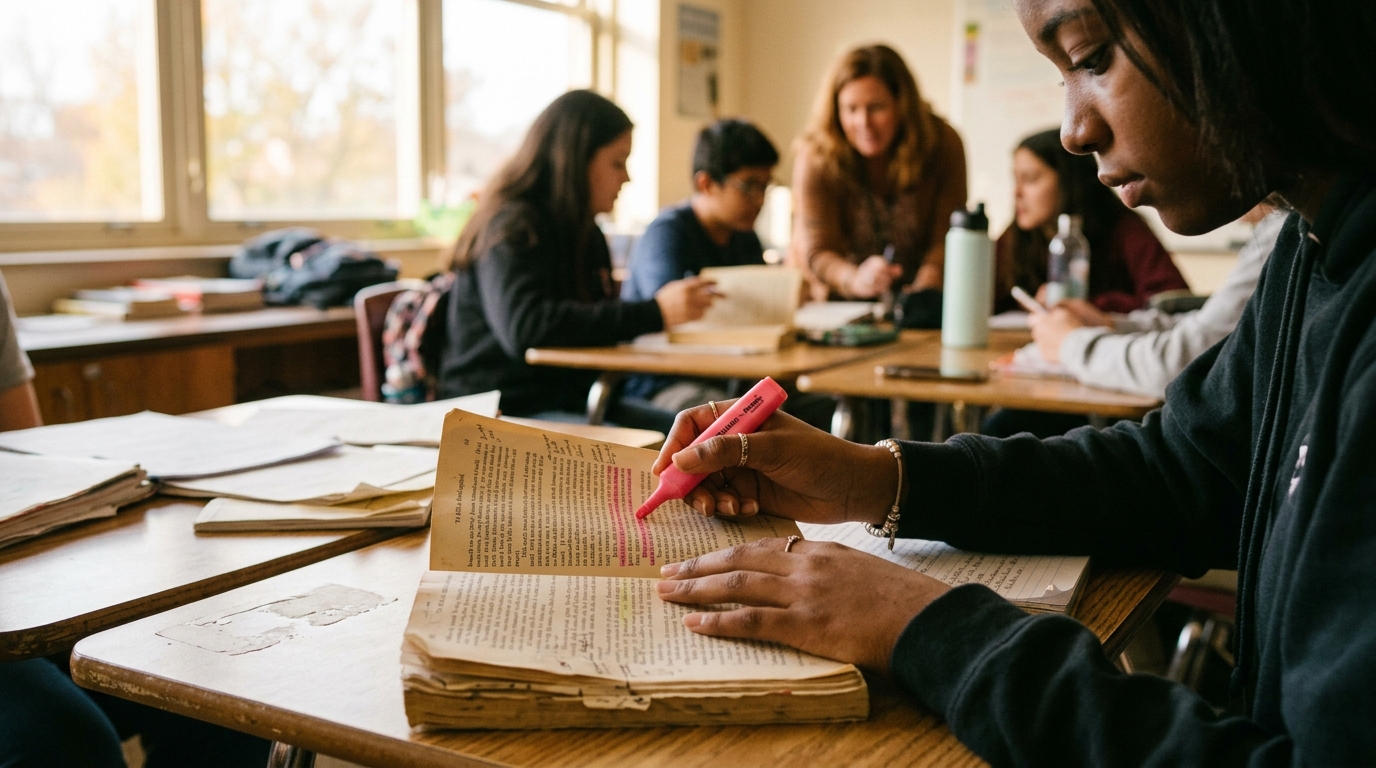
Step 3: Ask students to annotate for vague words, repeated ideas, unclear pronouns, or missing transitions.
Step 4: Model one or two sentence revisions. Show how to replace words like "stuff," "things," or "a lot" with precise terms.
Step 5: Students rewrite independently or with a partner.
Step 6: Compare versions and discuss which revisions improved clarity, accuracy, and tone.
The key is consistency. A routine does not need to be long to be powerful. It needs to happen often enough that students internalize the moves.
The obstacles schools are navigating
Of course, no routine succeeds just because it sounds sensible on paper. Secondary teachers are managing large classes, wide reading ranges, chronic absenteeism, curriculum pacing pressure, and limited intervention time. Many students are reading below grade level while also being asked to master grade-level content. Some schools have strong literacy coaching; others are asking teachers to build the plane while flying it.
That reality matters. Teachers cannot be expected to fix years of unmet reading needs through goodwill alone.
What makes transcript rewriting promising is that it does not require a new course, a costly program, or a total overhaul of curriculum. It can be embedded into what teachers already teach. It also respects students who may resist activities that feel elementary. Revising a transcript feels purposeful and grown-up, especially when the source comes from their actual class content.
How to make the routine stronger
A few design choices matter.
First, keep the cognitive demand high but the text length short. Students should wrestle with meaning, not drown in volume.
Second, teach revision language explicitly. Give students a bank of moves such as "replace vague nouns," "combine related ideas," "add a transition," "name the cause," or "use a content term."
Third, protect accuracy. In content classes, better writing should not distort the original idea.
Fourth, use gradual release. Some students will need sentence frames, word banks, or side-by-side examples before they can revise independently.
Fifth, build in talk. Brief partner discussion before rewriting often improves the final written product because students rehearse meaning orally first.
Concrete, realistic next steps for schools
Schools do not need to start big. They need to start clearly.
Begin with one grade level or one department and test the routine for six weeks.
Use existing materials: lecture notes, classroom discussion transcripts, video captions, or teacher-created summaries.
Agree on a small shared rubric with three traits: clarity, precision, and use of academic vocabulary.
Give teachers planning support, even if it is modest. Twenty minutes in a team meeting to select texts and compare student work is more useful than a vague call to "do more literacy."
Ask interventionists, ELA teachers, and content teachers to co-create a few model examples so expectations are aligned.
Track simple evidence: student samples over time, teacher observations, and whether students are using stronger language in discussion and writing.
Most of all, treat literacy improvement as steady rebuilding, not a quick fix. Secondary students can and do grow as readers when schools give them repeated chances to work with complex ideas in manageable ways.
The transcript rewrite routine will not solve every reading challenge. But it is the kind of practical, respectful strategy schools need right now: light enough to use, strong enough to matter, and flexible enough to help students read for meaning in every class they enter.