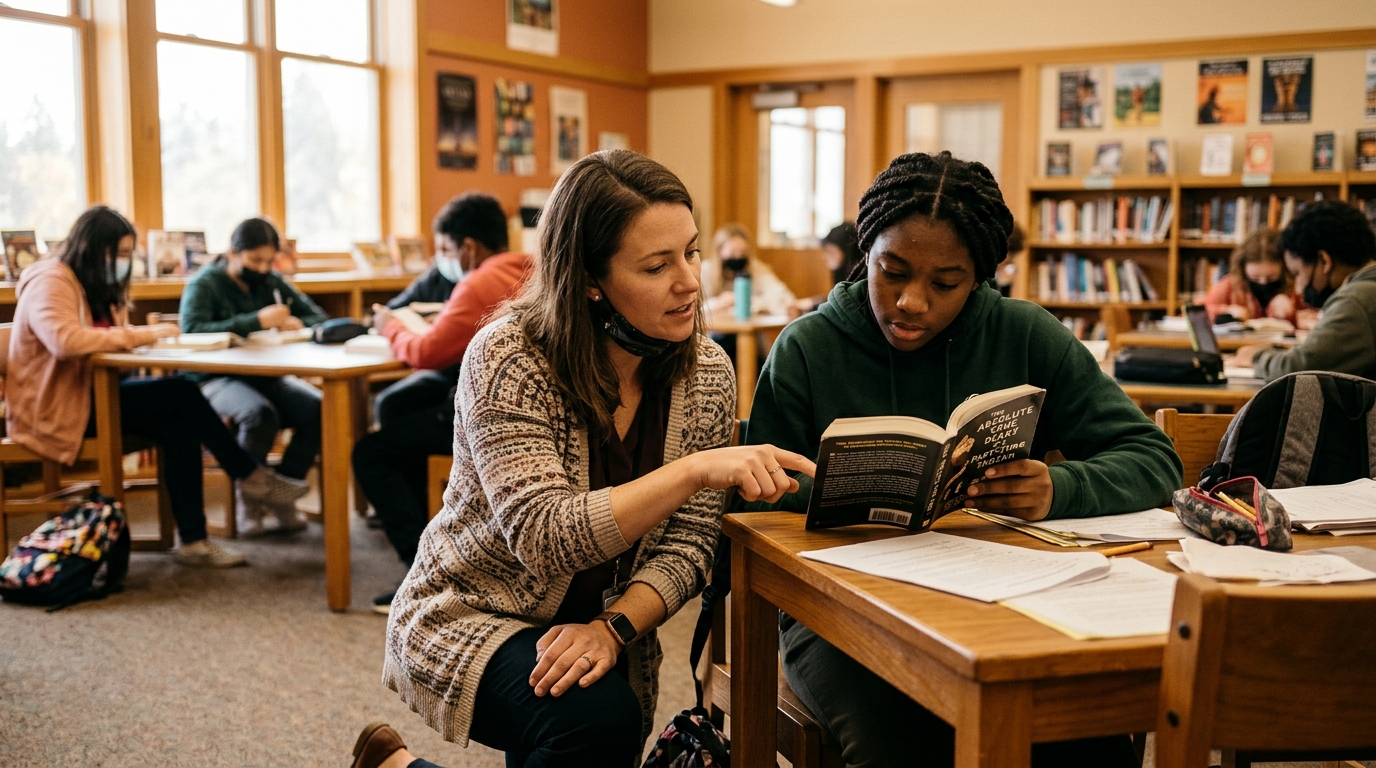
Secondary teachers are being asked to raise literacy rates in classes that are larger, more diverse, and more demanding than ever. This playbook offers realistic, research-aligned ways to strengthen adolescent reading without pretending schools have unlimited time, staffing, or money.
Why this matters now
In too many middle and high school classrooms, students are expected to read complex texts before they have the decoding, fluency, vocabulary, and background knowledge to do so with confidence. That gap is not a small problem to be solved by one intervention period or a new set of posters. It affects access to science, history, math, career pathways, and graduation itself.
The urgency is clear in national data. The National Assessment of Educational Progress (NAEP) reported that in 2022, average reading scores fell for both 8th graders and 12th graders, continuing a troubling long-term pattern for many students. Those results did not appear out of nowhere. Pandemic disruptions made things worse, but the underlying issue predates 2020: many adolescents have never fully secured the reading foundations they need, and secondary schools often are not structured to teach those foundations explicitly.
That is where the science of reading matters. Not as a slogan, and not as an elementary-only movement, but as a practical body of evidence about how reading develops and how schools can respond when older students are still struggling.
What the science of reading means in grades 6-12
At its core, the science of reading brings together decades of research from education, cognitive science, linguistics, and psychology. For secondary schools, the key message is simple: if students cannot read the words accurately and automatically, cannot make sense of syntax and vocabulary, or lack the background knowledge to connect ideas, comprehension will suffer.
That means adolescent literacy support has to go beyond generic advice like “find the main idea” or “use context clues.” Those strategies may help some students some of the time, but they do not replace explicit teaching in the building blocks of skilled reading.
In grades 6-12, those building blocks often include:
- advanced decoding and multisyllabic word reading
- fluency practice that builds accuracy, rate, and phrasing
- morphology, including prefixes, suffixes, and roots
- academic vocabulary taught in context
- sentence-level comprehension, especially for complex syntax
- knowledge-building through content-rich reading
For secondary teachers, this can feel like a mismatch with the demands of their courses. A biology teacher may reasonably ask, “Am I supposed to become a reading interventionist too?” The fair answer is no. But every teacher can teach the language, structures, and reading demands of their discipline, while schools create stronger targeted support for students who need intensive help.
The overcrowded class problem is real
Any honest literacy plan for secondary schools has to start with reality. Many teachers face 30 or more students at a time, wide skill ranges, inconsistent attendance, limited intervention staffing, and pressure to cover large amounts of content. In some schools, one class includes fluent readers, multilingual learners, students with IEPs, and students reading years below grade level.
No serious person should pretend that one teacher, alone, can solve all of that through effort and goodwill.
High-performing systems abroad offer useful perspective, but not magic. Countries such as Singapore, Estonia, Canada, and Finland often draw attention in international comparisons like PISA, organized by the OECD. Those systems differ in important ways, but many share a few habits: strong teacher preparation, coherent curricula, and sustained attention to language and knowledge development. The lesson for US secondary schools is not to copy another country wholesale. It is to notice that literacy improves when instruction is systematic and support is organized, not left to chance.
What secondary students actually need
Older struggling readers are often taught as if comprehension is their only issue. In reality, many need support in several layers at once.
Some need direct work in decoding, especially with multisyllabic academic words such as “constitutional,” “photosynthesis,” or “industrialization.” Others can decode but read so slowly that meaning breaks down. Many need explicit teaching in morphology, which is especially valuable in secondary classrooms because it helps students unlock subject-specific vocabulary. When students learn that “geo” relates to earth, “bio” to life, and “-ology” to the study of, thousands of words become more accessible.
They also need more reading volume, but not the kind that quietly buries them in frustration. Practice matters when texts are worthy, appropriately scaffolded, and followed by discussion and writing that deepen understanding.
A workable playbook for crowded classrooms
The good news is that secondary literacy improvement does not require every teacher to add a separate reading block. It does require a few consistent moves done well.
### 1. Teach vocabulary and morphology explicitly
Pick a small set of high-value words and word parts from upcoming texts. Teach meanings, pronunciation, examples, and how the parts work across words. In a crowded class, this is efficient because one well-chosen mini-lesson can support many students at once.
### 2. Make complex sentences visible
Adolescent readers often stumble not just on words but on sentence structure. Project one sentence from the text. Read it aloud. Break it into chunks. Identify the subject, verb, and key connectors like “although,” “however,” or “therefore.” This helps students handle the language of textbooks, primary sources, and lab reports.
### 3. Use short bursts of oral reading strategically
Round-robin reading is not the answer, but guided oral reading still matters. Choral reading, echo reading, partner reading, or teacher modeling of a difficult paragraph can improve fluency and reduce the cognitive load of dense text. In secondary settings, five focused minutes can be more powerful than a long, unfocused activity.
### 4. Build background knowledge before deep reading
Comprehension rises when students know something about the topic. Before assigning a complex article on Reconstruction or climate systems, give a brief knowledge primer: a visual, a short teacher explanation, a few essential terms, and one guiding question. This is not lowering the bar. It is building the ramp.
### 5. Ask text-dependent questions, not guess-the-teacher questions
Strong readers return to the text. Struggling readers need that habit taught clearly. Ask questions that require students to locate evidence, interpret specific phrases, compare claims, or explain how a paragraph develops an idea. Keep the questions sequenced so students experience success moving from literal understanding to inference.
### 6. Protect intervention for students with the greatest need
Some adolescents need more than classroom scaffolds. They need explicit, systematic intervention in decoding, fluency, and language comprehension. If schedules are tight, schools can still prioritize short daily or near-daily intervention blocks, delivered by trained staff, for the students furthest behind. This is one of the hardest staffing challenges schools face, but it is also one of the most important.
### 7. Share responsibility across departments
Literacy cannot live only in English class. Science teachers can teach how to read explanations and lab procedures. History teachers can model sourcing and contextualizing. Career and technical teachers can teach the reading demands of manuals, diagrams, and workplace documents. Students benefit when every class reinforces that reading is how knowledge is built.
What school leaders can do next
If you lead a school, start small but coherent. Audit where students are struggling: word reading, fluency, vocabulary, comprehension, or all of the above. Review schedules to see whether intervention time is real or merely aspirational. Give teachers usable routines, not another binder.
Professional development should be practical and ongoing. Secondary teachers need support in teaching morphology, vocabulary, sentence comprehension, and disciplinary reading without feeling that their content has been pushed aside. They also need curriculum materials that include strong texts, scaffolds, and opportunities for writing grounded in reading.
Finally, be careful with promises. NAEP will not turn around in a semester, and schools serving large numbers of students with unfinished learning will need time. But progress is possible.
The hopeful truth
The science of reading does not offer a miracle cure for overcrowded secondary classes. It offers something more useful: a clearer map. It tells us that older students can still grow as readers when schools address the real causes of difficulty, teach language and text structures explicitly, and organize support around what students actually need.
In an era of big classes and limited resources, that clarity matters. Teachers do not need blame. They need a playbook that respects both the evidence and the daily realities of school. Start with explicit vocabulary, sentence work, guided reading, knowledge-building, and targeted intervention. Done consistently, those moves can help more adolescents read with accuracy, stamina, and understanding—and that changes far more than test scores.