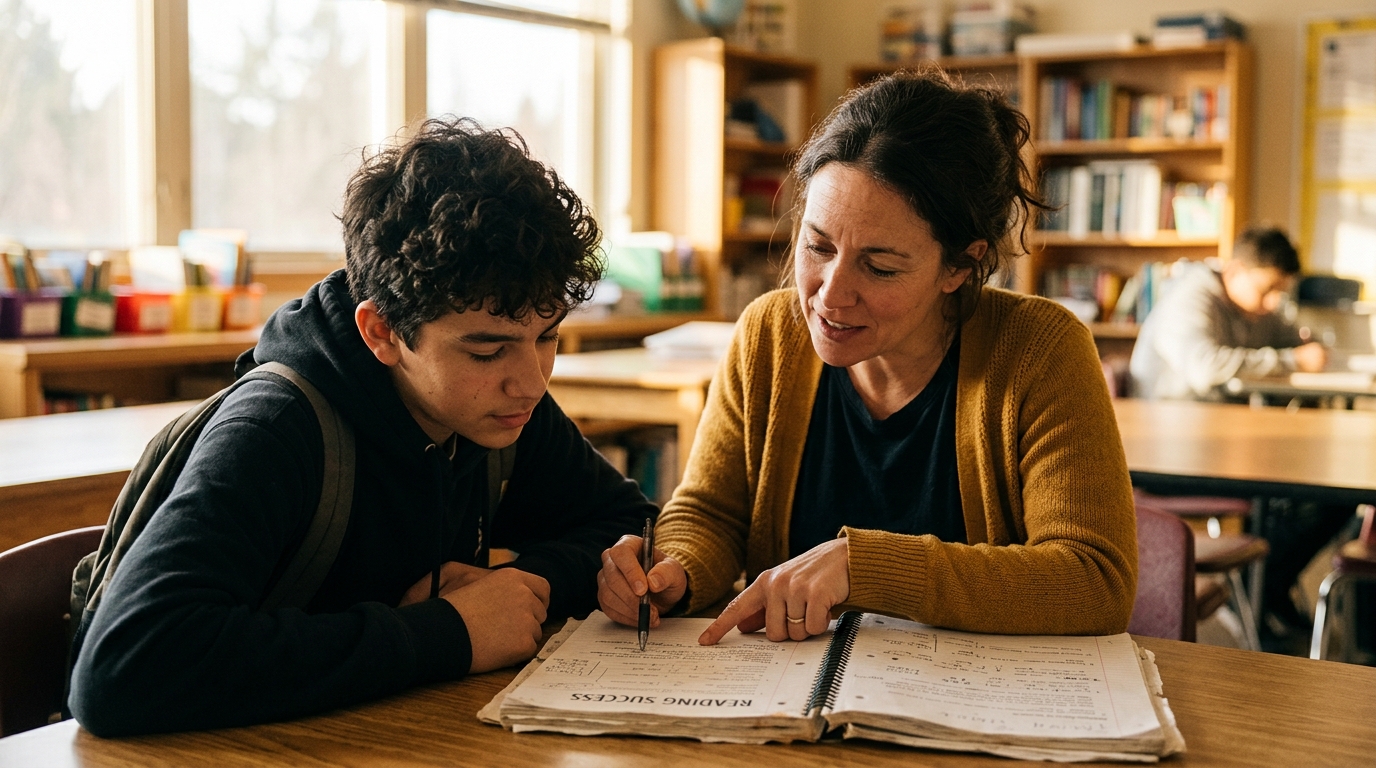
In many middle and high schools, a well-designed reading recovery elective does more than raise literacy scores. It can protect access to band, choir, art, and CTE by helping struggling readers catch up without being pulled from the classes that keep them connected to school.
For secondary schools, literacy is rarely just a literacy issue. It is a scheduling issue, an identity issue, and often an equity issue too.
When a sixth grader arrives reading years below grade level, the school has to make hard choices. Do you double-block English? Add an intervention class? Pull the student from an elective? On paper, that can look efficient. In practice, it often means the student loses band, choir, robotics, art, or another class that makes school feel like a place they belong.
That tradeoff is one of the quiet tragedies of secondary schooling. The very students who most need strong relationships, motivation, and reasons to come to school are often asked to give up the courses that provide them.
A better approach is possible: a reading recovery elective built for grades 6-12 that accelerates literacy growth while protecting students' access to the classes that anchor engagement. It is not easy, and it is not cheap in staff time or scheduling effort. But for many schools, it is more realistic than continuing to lose kids academically and emotionally by treating intervention as a punishment.
Why secondary literacy needs urgent attention
The need is not hypothetical. National data show how many students are still struggling well past the primary grades. According to the National Assessment of Educational Progress, the 2024 NAEP reading results showed that average reading scores for both fourth and eighth graders remained below pre-pandemic levels. In eighth grade, a large share of students continue to perform below NAEP Proficient, and the long-term pattern is especially concerning for students who were already underserved.
That matters in every secondary classroom. By middle school, reading difficulty is no longer confined to English class. It shows up in science labs, social studies documents, math word problems, CTE manuals, and digital research tasks. Students are expected to read to learn, but many are still learning how to read complex text.
Teachers know this. They see students who can decode some words but cannot summarize a paragraph, infer from a source, or navigate academic vocabulary. They see the student who loves percussion but cannot independently read the written directions on an assignment. They see the ninth grader who avoids reading aloud not because of attitude, but because years of struggle have taught him to hide.
Why pulling kids from electives backfires
Schools often build intervention schedules from the master schedule outward rather than from adolescent development inward. The result is predictable: reading support lands where there is room, and electives become the sacrifice.
But electives are not extras for many adolescents. They are where competence becomes visible. A student who feels lost in core classes may feel expert in trumpet, welding, digital design, or culinary arts. That sense of success matters.
Attendance, persistence, and school identity are shaped by those experiences. Ask almost any secondary principal or counselor why a student keeps showing up, and the answer is often tied to a person or a program: band, theater, athletics, JROTC, journalism, auto shop. Remove that connection, and the intervention may solve one problem while deepening another.
There is also a practical instructional issue. If intervention is framed as removal from valued courses, students quickly learn to resent it. Engagement drops before the first lesson starts. Families may resist placement. Teachers inherit a class of students who feel labeled.
A reading elective should not communicate, "You lost your spot in something meaningful because you are behind." It should communicate, "We are giving you an additional pathway to become more powerful in every class, including the ones you love."
What a strong reading recovery elective looks like in grades 6-12
Secondary reading intervention cannot be a watered-down elementary block. Older students need age-respectful materials, explicit instruction, and visible connection to the demands of their actual classes.
A strong model usually includes several features.
First, placement should be driven by evidence. Schools need a combination of screening data, classroom performance, and teacher input. A single test score is not enough. Some students need foundational work in decoding and fluency. Others can read words accurately but need support with vocabulary, comprehension, background knowledge, and written response.
Second, instruction should be explicit and targeted. Students who have missed foundational skills often need systematic work in multisyllabic decoding, morphology, fluency, and syntax. Students with stronger basic skills may need heavy practice with summarizing, inference, text structure, note-taking, and academic vocabulary. Secondary intervention works best when it is precise, not generic.
Third, materials must preserve dignity. Teenagers know when a program is made for little kids. Texts should be accessible without being childish. High-interest nonfiction, short articles, career texts, speeches, and content-connected reading can all work well.
Fourth, the class should build transfer. Students should leave able to use strategies in history, biology, algebra, and electives. That means teaching them how to annotate directions, unpack prompts, study new terminology, and monitor understanding.
Fifth, progress monitoring must be frequent but manageable. Teachers need enough data to adjust groups and goals, but not so much testing that intervention time disappears into assessment.
Lessons from higher-performing systems
No country offers a simple blueprint, and international comparisons should be used carefully. Still, they provide useful perspective. On the Programme for International Student Assessment, systems such as Singapore, Estonia, and Canada have often performed strongly in reading. Their success does not come from one miracle program. It comes from coherent systems: strong teacher preparation, early identification, consistent academic expectations, and support structures that do not treat intervention as an afterthought.
Finland, often discussed in education conversations, has also long emphasized early support and specialized help before students fall too far behind. The lesson for US secondary schools is not to import another country's model whole cloth. It is to notice a pattern: effective systems intervene with skill, dignity, and coordination.
That same principle applies in an American middle or high school. If literacy support is disconnected from the rest of the day, students experience it as one more isolated class. If it is coordinated with core instruction and student interests, it becomes a lever rather than a label.
The scheduling challenge is real
Of course, schools do not redesign schedules in theory. They do it with limited staffing, crowded master schedules, special education minutes, transportation constraints, graduation requirements, and classes that are already too large.
That reality matters. It is easy to tell schools to "just add intervention" without acknowledging what that means. Someone has to teach it. Someone has to train staff. Someone has to decide which courses run with lower enrollment and which do not. In many districts, especially rural and under-resourced ones, there may be one reading specialist for an entire secondary campus, or none at all.
This is why the best reading electives are often built through compromise rather than ideal design. A school may start with one grade level, one intervention period, or one teacher team. It may embed support within an existing elective wheel or create semester-long sections instead of full-year courses. Those are not signs of weak commitment. They are signs of working within reality.
How to keep kids in band while raising literacy
The most promising schools treat literacy intervention and elective access as connected goals, not competing ones.
One approach is to place reading intervention in a dedicated elective slot and protect at least one student-choice elective elsewhere in the schedule. Another is to use flexible intervention cycles so students do not lose the same elective for an entire year. Some schools prioritize summer catch-up, before-school tutoring, or high-dosage small-group support during advisory to reduce the number of students needing replacement courses during the day.
Schools can also design intervention around student identity. If a student is in band, the message should be clear: this class exists to help you stay successful in band and everywhere else. Teachers can incorporate music-related texts, performance schedules, and content-area vocabulary to make the purpose visible.
Family communication matters too. Parents are more likely to support placement when they understand that the goal is acceleration, not punishment, and when the school can explain how the student will still have room for valued electives over time.
Realistic next steps for schools
Schools do not need a perfect overhaul to begin. They need a few disciplined moves.
Start by auditing who is losing electives for intervention and for how long. If the same students are consistently giving up the classes that connect them to school, that is a warning sign.
Use multiple measures to place students in intervention and separate students who need foundational decoding support from those who primarily need comprehension and vocabulary work.
Protect at least one high-interest elective whenever possible, especially for students with histories of disengagement or chronic absenteeism.
Train intervention teachers in adolescent literacy, not just generic remediation. Secondary students need explicit instruction delivered with respect.
Coordinate between intervention teachers, English teachers, and content-area teachers so students practice strategies across classes.
Monitor progress every few weeks and exit students when they are ready. An intervention class should be a bridge, not a permanent track.
And finally, talk about literacy support in asset-based language. Students are not being removed from real school so they can do remedial work. They are being given tools to access more of school, more confidently.
That is the promise of a strong reading recovery elective in grades 6-12. It helps students read better, yes. But at its best, it also helps them remain musicians, artists, builders, athletes, and young people with a reason to stay connected. In a time when so many adolescents are asking whether school has a place for them, that may be one of the most important outcomes of all.