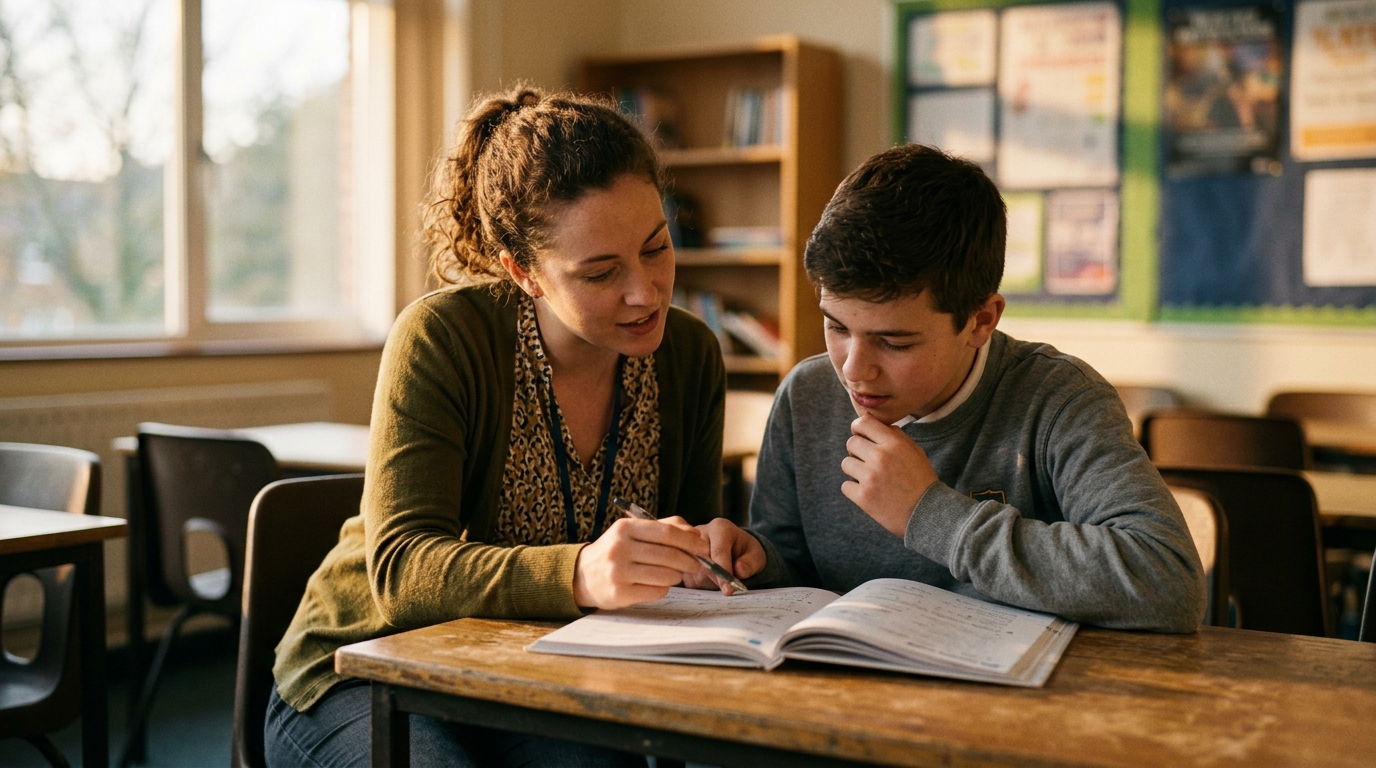
Secondary schools know adolescents need stronger reading support, but few can add a full intervention system overnight. A protected reading block can work when it is built around staffing reality, not wishful scheduling.
The problem is not awareness. It is capacity.
Most secondary educators do not need to be convinced that literacy matters. They see the evidence every day: students who can discuss a topic out loud but struggle to make sense of a textbook chapter, students who avoid reading because it is slow and exhausting, students who can decode but cannot summarize, infer, or evaluate an argument. In grades 6-12, literacy is no longer one subject among many. It is the access point to all of them.
The urgency is real. On the 2022 National Assessment of Educational Progress, often called the Nation’s Report Card, average reading scores for both fourth and eighth graders declined compared with 2019, and eighth-grade reading continued a long-term pattern of concern. Those results did not create the problem, but they made it harder to ignore. When students arrive in middle and high school with unfinished reading development, every department inherits the challenge.
And yet many secondary schools are being asked to improve literacy under conditions that are plainly difficult: limited staffing, tight master schedules, vacancies in intervention roles, large class sizes, uneven student attendance, and course requirements that already crowd the day. It is easy to propose a daily intervention period in theory. It is much harder to build one that a school can actually staff from August to May.
That is why the idea of a protected reading block matters. Not a perfect block. Not a boutique model that depends on extra personnel most schools do not have. A protected reading block that works within real constraints and still gives struggling readers more time, better instruction, and more consistent support.
What a protected reading block is — and is not
A protected reading block in secondary school is a scheduled, consistent period dedicated to reading development for students who need it most. “Protected” means the time is not casually absorbed by assemblies, make-up work, test prep for other subjects, or a rotating list of school business. If literacy is everyone’s priority, it needs some time that is genuinely reserved for literacy.
Just as important, a protected reading block is not simply silent reading with good intentions. Independent reading has value, especially when students have access to books they can read and want to read. But students with significant reading gaps usually need explicit instruction as well: vocabulary, fluency, comprehension routines, text structure, background knowledge, and opportunities to read with support.
In stronger models, the block blends three things: direct instruction in reading, supported practice with grade-appropriate text, and meaningful volume of reading over time. The exact balance may vary by grade level and student need, but the principle is steady. Adolescents improve when schools provide both instruction and practice, not one without the other.
Why secondary schools struggle to create one
Elementary schools often have an easier case for a reading block because literacy is already central to the school day. Secondary schools are different. Credits, graduation requirements, electives, advanced courses, career pathways, and intervention demands all compete for minutes. In many places, there is no “empty” period waiting to be repurposed.
Staffing is the second barrier. A school may agree that hundreds of students need stronger reading support, but still lack enough trained reading specialists to deliver it. That does not mean the effort should be abandoned. It does mean the design must be realistic.
A workable secondary model usually avoids two mistakes. The first is assigning the entire burden to English teachers alone. They are essential, but they cannot be the only literacy safety net for the whole building. The second is assuming every teacher can become a reading interventionist after one professional development session. Content-area teachers can absolutely support disciplinary literacy, but targeted intervention for older struggling readers requires more structure and support than a quick training can provide.
What we can learn from stronger systems
International comparisons should be used carefully; no country can be copied wholesale. But they can still offer perspective. On the OECD’s Programme for International Student Assessment, or PISA, countries such as Estonia, Canada, and Singapore have shown strong reading performance over time. Their success does not come from one magic schedule. It comes from coherence: attention to teacher development, a serious academic culture, and early, sustained support for students who struggle.
Finland is often cited for reading as well, though its recent results have also shown declines, a useful reminder that no system is permanently solved. The lesson for US secondary schools is not “be Finland.” The lesson is that strong literacy outcomes usually grow from consistency, not from one-time initiatives. Students need protected time, skilled teaching, and intervention that lasts long enough to matter.
A staffing model schools can actually use
The most practical version of a protected reading block is targeted rather than universal. Not every student in grades 6-12 needs a separate reading class. Many do need stronger literacy instruction in regular English and content classes, but a dedicated intervention block should primarily serve students with the clearest reading needs, identified through local data such as screening, course performance, teacher input, and state assessment trends.
In middle school, this often means replacing one elective for a defined period with a reading support class for students who are far below benchmark. That tradeoff is not ideal, and schools should be honest about it. But for a student who cannot yet access core texts independently, temporary intensified reading support may be the more equitable option.
In high school, schools can use a smaller footprint: a semester-based reading lab, a double-dose English course for ninth graders with the greatest need, or a credit-bearing literacy support class attached to English I. These designs are more schedulable than a whole-school daily literacy period.
Who teaches the block? Start with the staff already closest to the work: reading specialists where available, interventionists, English teachers with strong literacy expertise, special education teachers whose schedules permit, and instructional coaches only if their assignment truly allows direct teaching. Some schools also make strategic use of paraprofessionals for supervised practice groups, but they should not be expected to deliver core reading instruction without training and oversight.
The key is to reserve the most expert teachers for the students with the deepest need, keep group sizes manageable where possible, and standardize materials enough that the program does not depend entirely on one heroic individual.
What should happen during the block
A useful reading block is calm, predictable, and instructionally tight. It does not try to fix every literacy issue at once.
A simple routine might include a short fluency or vocabulary warm-up, explicit teaching of one comprehension or language skill, guided reading of an appropriately challenging text, and time for independent or partner practice with feedback. For older students, the texts should not feel babyish. High-interest, age-respectful materials matter, especially for students who have already experienced years of frustration.
Progress monitoring should be light but regular. Schools do not need to drown teachers in spreadsheets. They do need a way to see whether students are gaining accuracy, stamina, comprehension, or confidence over time.
The whole school still has a role
A protected reading block cannot carry literacy growth by itself. Students spend most of the day elsewhere, and every department influences reading demands. Science teachers ask students to interpret explanations and evidence. Social studies teachers ask them to analyze sources. Career and technical teachers ask them to follow procedures and read informational text. Secondary literacy improves faster when schools combine intervention with stronger reading routines across classes.
That does not mean every teacher must teach reading the same way. It means departments can agree on a few common supports: pre-teaching key vocabulary, chunking complex text, modeling annotation, asking text-dependent questions, and giving students repeated opportunities to write about what they read. These are feasible shifts when leaders keep the ask focused.
Start smaller, protect it better
Schools do not need a grand literacy redesign before they begin. In fact, smaller and steadier is usually wiser.
Start by identifying the students with the most urgent need. Protect one period or one course structure for them. Staff it with the strongest available people. Use a limited set of materials and routines. Track whether students are improving. Then expand carefully.
A realistic plan for secondary literacy improvement might include five commitments: protect intervention time from constant interruption; prioritize the highest-need students first; give teachers usable training and planning time, not just slogans; build light, regular progress checks; and support literacy practices across content areas without pretending all teachers have the same role.
There is no painless version of this work. Schedules will be tight. Staffing will still be imperfect. Some tradeoffs will be uncomfortable. But secondary schools do not need an idealized model to make real progress. They need a reading block they can actually staff, protect, and sustain.
That kind of plan may not look dramatic on a presentation slide. In real schools, it is often the plan that lasts long enough to help students read more capably, more confidently, and with a better chance of success in every class that follows.