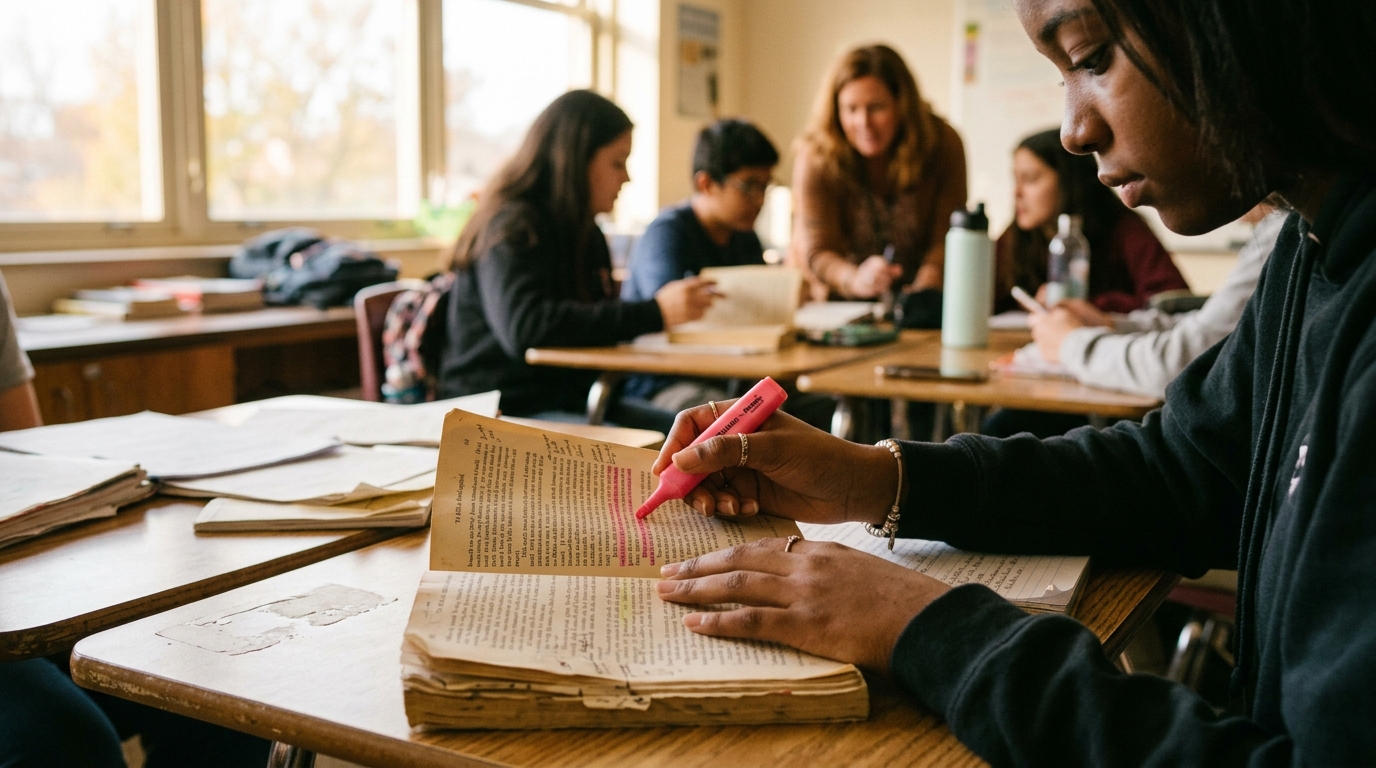
Ninth grade is where many students quietly decide whether school is for them. A reading apprenticeship approach can raise literacy in secondary classrooms by treating reading as a shared, visible practice—and by rebuilding trust one text, one routine, and one relationship at a time.
Why 9th Grade Matters So Much
Ninth grade has always carried unusual weight. It is the year when students meet the full demands of high school reading: longer texts, denser vocabulary, faster pacing, and less hand-holding. It is also a year when many students are deciding, often silently, whether they belong in academic spaces at all.
That is why literacy work in secondary school cannot be reduced to test prep or a remedial program tucked away in one corner of the building. If students are going to grow as readers in grades 6-12, they need more than strategies. They need trust: trust that teachers will not expose them, trust that confusion is normal, and trust that reading is something people learn to do better through practice, talk, and support.
A reading apprenticeship approach speaks directly to that need. At its heart is a simple idea: expert reading is often invisible, so teachers and students make it visible together. Instead of acting as if strong readers naturally "get it," classrooms slow down the process. They notice where meaning breaks down. They name the moves that help. They treat reading as an apprenticeship into the habits of a discipline.
The Literacy Challenge in Secondary Schools
The need is real, and it is not confined to one subgroup of students. According to the National Assessment of Educational Progress, average reading scores in 2022 fell for both 8th and 12th graders compared with earlier years. NAEP has also long shown stubborn gaps in reading performance by income, race, disability status, and English learner status. Those numbers matter, but teachers do not need a federal report to know what they are seeing. Many middle and high school students can decode adequately and still struggle to make sense of complex text, track an argument, interpret evidence, or persist when reading gets hard.
Schools are trying to respond under very real constraints. Secondary teachers often see 120 to 170 students a day. Course pacing guides are crowded. Intervention blocks compete with graduation requirements. Staffing shortages make small-group support difficult. And content-area teachers are frequently told to "teach literacy" without enough time, training, or coordination.
This is where trust can fray. Students who have spent years feeling behind may protect themselves by opting out, joking, avoiding, or declaring reading "boring." Teachers, under pressure to cover content, can feel forced to keep moving. Neither response is a character flaw. Both are understandable reactions to systems that ask too much, too quickly, with too little support.
What Reading Apprenticeship Looks Like
A reading apprenticeship model does not ask every teacher to become an elementary reading specialist. It asks secondary educators to do something both more modest and more powerful: make the reading demands of their subject visible and teach students how to meet them.
In a history class, that may mean modeling how to source a document, note bias, and compare claims. In science, it may mean showing students how to unpack a diagram, monitor understanding across a lab report, and reread a technical paragraph for precision. In English, it may mean thinking aloud through a difficult passage, naming where interpretation is uncertain, and demonstrating how readers use context, syntax, and prior knowledge to build meaning.
The trust-building piece matters just as much as the strategy piece. Teachers openly acknowledge that complex text is challenging—even for adults. Students talk about what they notice in their own reading process: when they lose the thread, what helps them recover, which routines reduce panic. Over time, reading becomes less of a private test of intelligence and more of a shared intellectual practice.
That shift is especially important in 9th grade. Adolescents are acutely aware of status. They know who seems fluent and who hesitates. A classroom where only the fastest readers feel safe will not produce broad literacy gains. A classroom where struggle is normalized, and where the teacher treats students as capable apprentices, has a much better chance.
Lessons From Higher-Performing Systems
International comparisons should be used carefully, but they can still offer perspective. On PISA, the OECD's international assessment of 15-year-olds, countries such as Singapore, Estonia, Canada, and Finland have often performed strongly in reading over time. These systems are not identical, and the United States cannot simply import another country's school structure. Still, some shared themes are worth noticing.
First, literacy is not treated as the sole responsibility of one department. Students are expected to read, discuss, and write across subjects. Second, teacher preparation and professional learning matter. Strong systems invest in helping teachers understand how students learn and how disciplinary reading works. Third, support is more coherent. Students do not just receive a label; they receive routines, feedback, and time.
None of that is glamorous. It is steady capacity-building. And that is good news for American schools, because trust is built the same way: through consistent structures, not heroic one-off lessons.
Why Trust Comes Before Growth
Students read better when they are willing to stay with difficulty. That willingness is deeply connected to trust. If a student believes that confusion will lead to embarrassment, they will disengage quickly. If they believe the classroom has tools for getting unstuck, they are more likely to try.
Teachers rebuild that trust when they do three things consistently.
They make reading processes visible. A quick think-aloud—"This sentence is dense, so I'm going to reread and look for the verb"—shows students that skilled reading includes repair.
They create low-risk talk. Before a whole-class discussion, students can annotate silently, compare notes with a partner, or answer one focused question. That sequence lowers the social cost of participating.
They honor students' existing knowledge. Adolescents bring language, experience, and insight to the room. When literacy instruction starts from deficit, students hear that they are the problem. When it starts from apprenticeship, students hear that they are learning a demanding craft.
What Schools Can Realistically Do Now
Improving adolescent literacy does not require a perfect master plan. It requires a small number of shared moves, done well.
First, choose a few schoolwide reading routines. For example: short teacher think-alouds, annotation codes, partner sense-making, and sentence frames for evidence-based discussion. Consistency across classes reduces cognitive overload for students.
Second, focus on disciplinary literacy, not generic worksheets. Students should learn how reading works differently in algebra, biology, civics, and literature. This respects teachers' expertise and makes literacy instruction more authentic.
Third, protect time for collaborative planning. Even one common planning period every two weeks can help teachers align text demands, vocabulary support, and discussion routines. Schools do not need endless meetings; they need useful ones.
Fourth, use data carefully. NAEP and state assessments can highlight urgency, but classroom improvement depends on closer evidence: student annotations, discussion notes, short written responses, and conferencing. Teachers need information that helps them adjust instruction next week, not just rankings months later.
Fifth, build intervention without stigma. Ninth graders know when they are being sorted. Support works better when it is timely, targeted, and connected to real class texts rather than isolated drill.
Finally, invest in professional learning that respects secondary teachers' realities. They need models, examples, and time to try routines in their own content areas—not abstract mandates.
The Quiet Promise of Apprenticeship
The most powerful thing about a 9th-grade reading apprenticeship is that it changes the story students tell themselves. Instead of "I'm just not a reader," the message becomes, "I'm learning how readers in this class do the work."
That is not a small shift. It is the beginning of persistence, competence, and belonging.
Secondary schools face genuine obstacles in raising literacy rates, and no single framework will erase those barriers. But when teachers make reading visible, shared, and humane, they do more than improve comprehension. They rebuild trust in the possibility of learning itself.
And for many 9th graders, that may be the turning point that matters most.