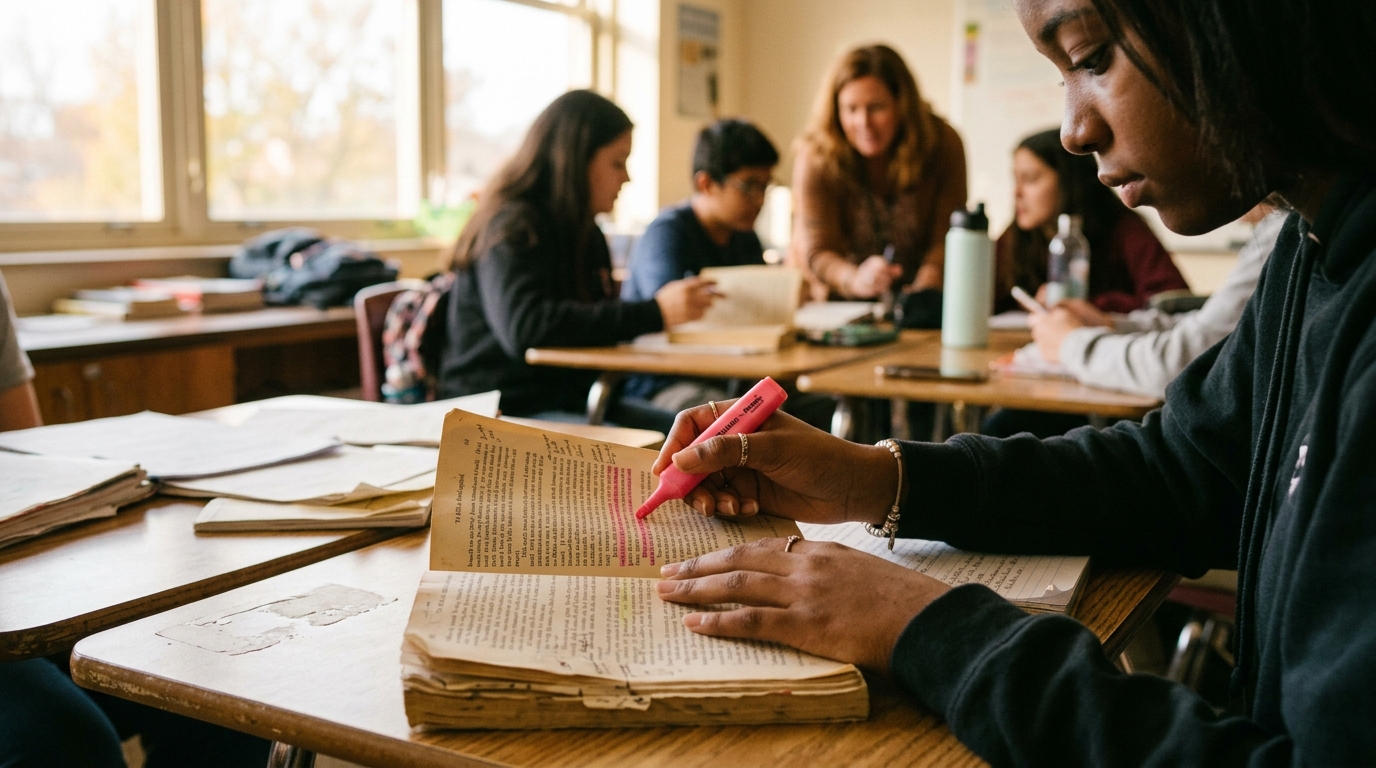
A short, routine fluency check can help secondary schools catch reading trouble before it becomes a ninth-grade crisis. The key is not adding one more program, but creating a realistic system that helps teachers notice, respond, and support students early.
Ninth grade has a way of exposing reading problems that have been building for years. Students who seemed to be getting by in middle school suddenly meet denser textbooks, faster pacing, more independent reading, and writing tasks that assume they can make sense of complex text on their own. For many, that transition is manageable. For others, it is where the slide begins.
Schools feel this deeply. Teachers are asked to raise literacy rates while managing large classes, attendance issues, staffing shortages, and the very real pressure of covering content. Secondary educators also inherit a common misconception: if a student has made it to grades 6–12, basic reading skills must already be in place. Often, they are not.
A simple 15-minute fluency check will not solve adolescent literacy by itself. But used well, it can help schools catch warning signs early enough to prevent a much steeper decline in confidence, coursework, and credit accumulation in ninth grade.
Why fluency still matters in secondary school
Fluency is sometimes treated as an elementary issue, but it matters well beyond third grade. In practical terms, fluency means reading with enough accuracy, pace, and phrasing that the brain has room left for understanding. When students labor over words, comprehension suffers. So does stamina.
That matters in middle and high school because the reading load changes. A sixth grader might read a science article with teacher support. A ninth grader may be expected to extract evidence from a primary source, annotate a chapter in biology, and read a novel independently in the same week. Students who are not fluent readers often hide in plain sight by listening well, copying peers, or avoiding reading aloud.
National data suggest why this deserves attention. On the 2022 National Assessment of Educational Progress, often called the Nation's Report Card, average reading scores declined for both fourth and eighth graders, continuing a troubling trend. NAEP also reported that a large share of students performed below the proficient level in reading. While NAEP proficiency is a high bar and not the same as grade-level status in a classroom, the results are a clear signal: many students are entering secondary school with reading needs that cannot be ignored.
The hidden risk behind the ninth-grade transition
By ninth grade, reading difficulties begin to collide with graduation requirements. Students are expected to read more independently across subjects, keep up with homework, and recover quickly when they miss instruction. If reading is slow, inaccurate, or exhausting, everything takes longer.
This is one reason ninth grade is such a pivotal year in many districts. It is where schools often see drops in attendance, course performance, and student confidence happen together. A student does not need to be a nonreader to struggle. Even moderate fluency weakness can make history chapters, algebra word problems, lab procedures, and written directions feel overwhelming.
The problem is not that secondary teachers do not care. It is that many schools lack a practical screening routine once students leave elementary grades. Without one, support often depends on failure becoming visible first.
What a 15-minute fluency check looks like
A good fluency check is brief, consistent, and low-stakes. It is not a public performance and it is not a label. It is a way to notice who may need a closer look.
In simplest form, a teacher, interventionist, or trained staff member listens to a student read a grade-appropriate passage aloud for about one minute, notes accuracy and rate, and follows with a few quick comprehension questions or a short retell. Across a class or grade level, schools can rotate students through these checks over several days during advisory, intervention blocks, English class, or another protected time.
The full cycle can fit inside 15 minutes when schools plan carefully: a short setup, a one-minute read, quick scoring, and a brief note about next steps. The goal is not perfect diagnosis on the spot. The goal is to identify students whose reading sounds effortful enough to warrant support.
This matters because adolescent reading problems are often mixed. One student may read quickly but understand little. Another may comprehend well when text is read aloud but struggle to decode multisyllabic words independently. A short fluency check helps schools separate these patterns instead of treating all reading difficulty as the same.
Why this works better than waiting for grades to drop
Grades are a lagging indicator. By the time a ninth grader is failing English, the issue may already be affecting every class. A brief fluency routine gives schools an earlier indicator.
It also helps teachers act on evidence they can use. A student who reads word by word, skips endings, or loses phrasing on simple sentences likely needs different support than a student whose oral reading is smooth but who cannot summarize what was read. That distinction matters for scheduling interventions, choosing materials, and deciding whether concerns point more toward decoding, language comprehension, vocabulary, or attention.
High-performing systems internationally offer a useful reminder here. Countries such as Finland, Estonia, Singapore, and Canada are often cited in PISA reading discussions not because they use one magic program, but because they tend to build coherent systems: early identification, teacher preparation, and structured support before students fall far behind. The lesson for US secondary schools is not to copy another country wholesale. It is to recognize that consistency beats improvisation.
The real barriers schools face
Of course, adding any new routine raises a fair question: when, exactly, are teachers supposed to do this?
That is the challenge. Secondary schedules are tight. Reading support staff are limited. Content teachers may feel unprepared to assess fluency, especially in grades where the expectation has long been "teach the subject" rather than "teach reading too." In many schools, intervention time is already overbooked.
Those constraints are real, and ignoring them does not help. The answer is not to ask every teacher to become a reading specialist overnight. It is to design a manageable shared practice.
That might mean screening only transition grades such as 6 and 9. It might mean using advisory or homeroom twice a year. It might mean training a small team of interventionists, coaches, paraprofessionals, and volunteers to run checks efficiently. What matters most is that the system is simple enough to sustain.
What schools should do after the check
A fluency check only helps if it leads to action. Students flagged for concern need a clear next step within weeks, not months.
For some students, the response may be targeted decoding and fluency practice using short, engaging texts and repeated reading with feedback. For others, vocabulary and background knowledge may be the bigger issue, especially in content-heavy courses. Some will need both.
Secondary schools can also make immediate classroom adjustments that do not require a new curriculum. Teachers can preview key vocabulary, provide guided reading questions, chunk longer passages, model how fluent reading sounds, and offer audio support when appropriate. None of these replaces intervention, but they reduce the daily penalty students pay while support is getting organized.
Just as important, schools should communicate carefully with families. A fluency concern should be framed as useful information, not a verdict. Adolescents are highly sensitive to embarrassment, and families may have heard years of mixed messages. Clarity and dignity matter.
Concrete, realistic next steps
If your school wants to try a 15-minute fluency check, start small.
First, choose one grade band, ideally grade 6 or grade 9, where transition demands are highest.
Second, use a common passage routine and a simple recording form so staff are looking for the same signs: accuracy, pace, phrasing, and basic understanding.
Third, train a small team rather than the whole faculty at once. Keep the process reliable before trying to scale it.
Fourth, set decision rules in advance. Decide what counts as "monitor," "intervene," and "refer for deeper assessment" so the screening does not end in a spreadsheet no one uses.
Fifth, connect the data to available support. Even one intervention period, one tutoring block, or one strategic grouping plan is better than identifying students and doing nothing.
Finally, repeat the check. Improvement matters, and students deserve to see that reading growth is possible.
Secondary literacy improvement is hard work. There is no shortcut around time, expertise, and sustained support. But there is a difference between a school that waits for ninth-grade failure and a school that looks early, notices carefully, and responds with purpose. Sometimes that difference starts with 15 minutes.